
After years of declining prices, mobile phone costs in Canada are starting to rise again.
A new nationwide survey of Canadians from NumberBarn finds that costs are increasing for many households, while confusion around pricing remains widespread.
- Canadians Are Changing Their Habits to Keep Phone Costs Down
- Hidden Fees and Pricing Confusion Are Driving Frustration
- The Provinces With the Highest Average Phone Bills in Canada
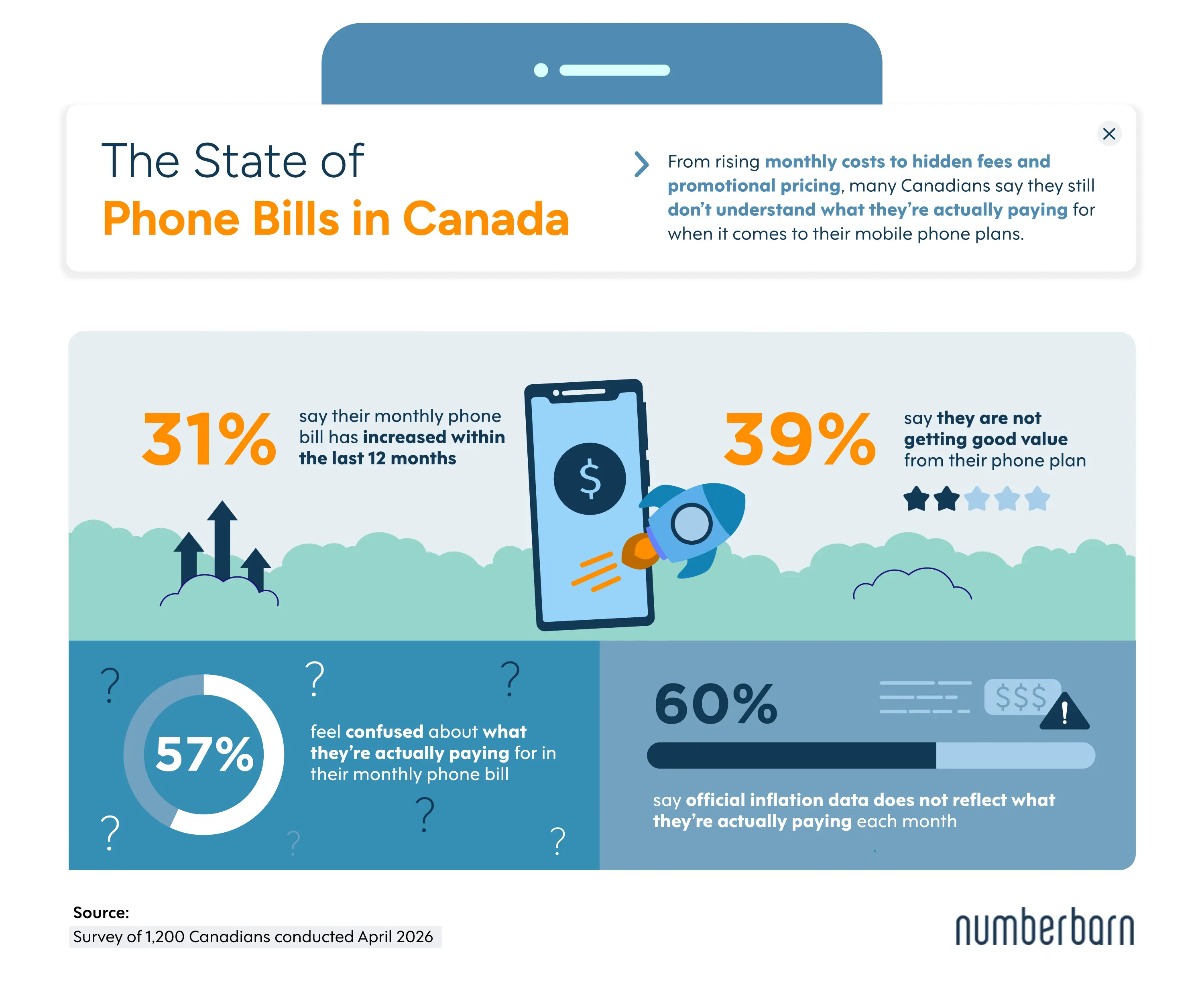
While Statistics Canada’s Cellular Services Price Index has shown reported mobile prices falling for years, six in 10 Canadians (60%) said official inflation data isn’t reflecting what they’re actually paying each month.
Many consumers also say they don’t feel they’re getting good value, nor fully understand what they’re paying for. More than half (57%) say they feel confused about their monthly phone bill, and 45% say they’ve felt misled by their provider’s pricing or promotional offers.
Key Findings
- 31% of Canadians say their monthly phone bill has increased within the last 12 months.
- More than 1 in 5 (22%) pay more than $100 per month for their mobile phone plan.
- Nearly 4 in 10 (39%) say they are not getting good value from their phone plan.
- 60% say official inflation data does not reflect what they’re actually paying each month.
- Residents in Alberta report the highest wireless phone bills in Canada. Residents pay an average of $84.28 per month, or $1,011.36 per year.
- Nationwide, the average monthly phone bill is $72.35.
Mobile phone costs remain a growing concern for Canadians.
Nearly 1 in 3 (31%) say their monthly phone bill has increased within the last 12 months, while more than 1 in 5 (22%) report paying over $100 per month. After roughly 30 months of year-over-year declines, cellular service prices measured by Statistics Canada’s Consumer Price Index (CPI) started increasing late last year.
But rising costs aren’t the only issue. Many Canadians also question whether they’re getting value.
Nearly 4 in 10 (39%) say they are not getting good value from their phone plan, suggesting that higher bills aren’t translating into better service or benefits.
Confusion around pricing may be a key factor. More than half of Canadians (57%) say they don’t fully understand what they’re paying for, while 45% say they’ve felt misled by pricing or promotional offers.
And that confusion extends beyond their monthly phone bills. Overall, six in 10 Canadians (60%) say inflation data does not reflect what they’re actually paying each month.
Part of that disconnect may stem from how telecom prices are measured. Statistics Canada’s pricing data factors in promotional discounts and larger data packages as “quality adjustments,” which may not fully reflect what consumers ultimately pay each month.
In other words, that means that if your plan price stayed the same, but your data allowance doubled, Statistics Canada would count that as a price decrease, even if your bill didn’t change.
Canadians Are Changing Their Habits to Keep Phone Costs Down
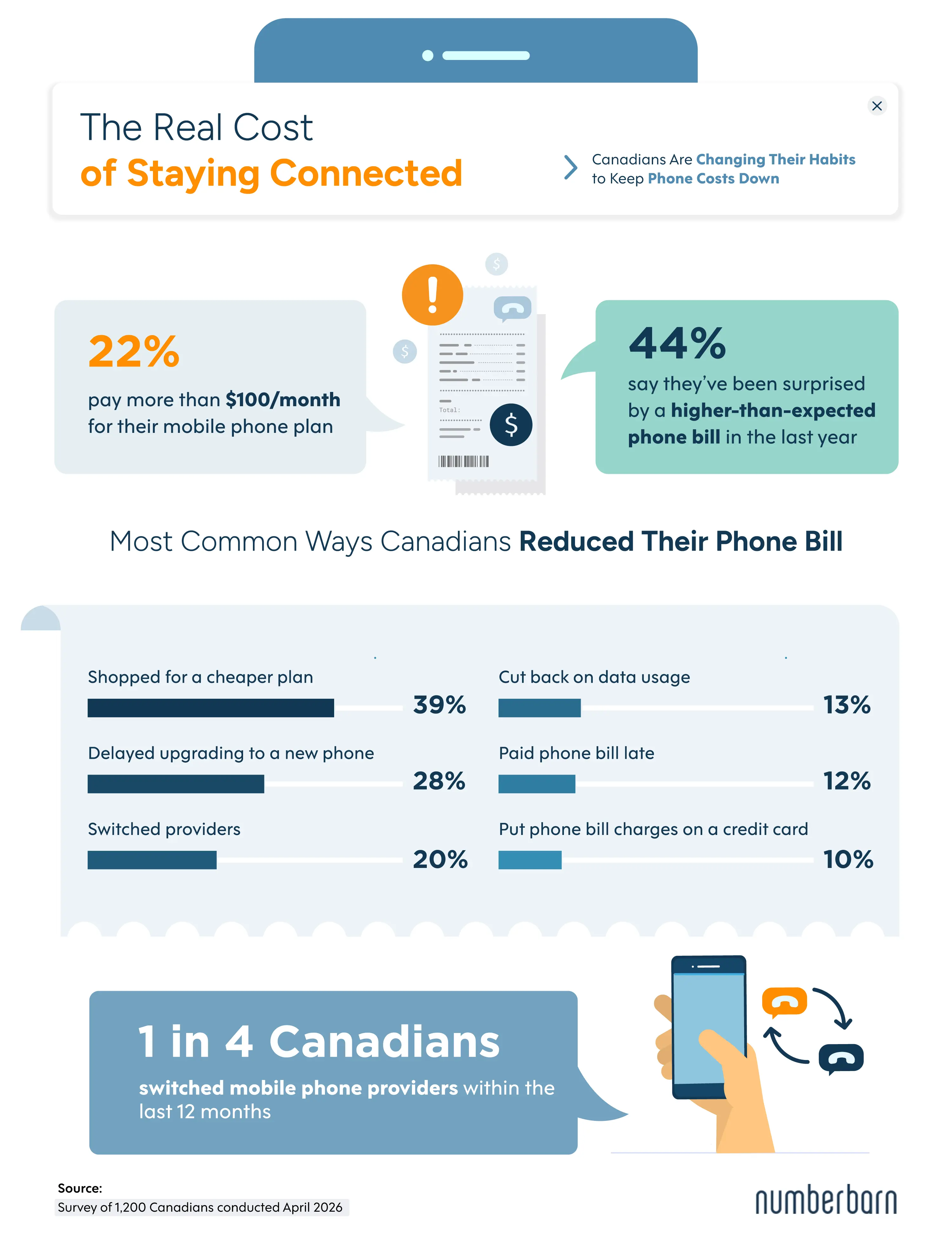
As phone costs continue to rise, many Canadians are adjusting their habits to manage their monthly bills.
Nearly 4 in 10 (39%) say they’ve shopped for a cheaper plan in the past year, making it the most common way consumers are trying to reduce costs. Others are delaying upgrades (28%) or switching providers altogether (20%) in search of better deals.
Unexpected costs may be driving some of these behaviors. Nearly half of Canadians (44%) say they’ve been surprised by a higher-than-expected phone bill within the past year.
Hidden Fees and Pricing Confusion Are Driving Frustration
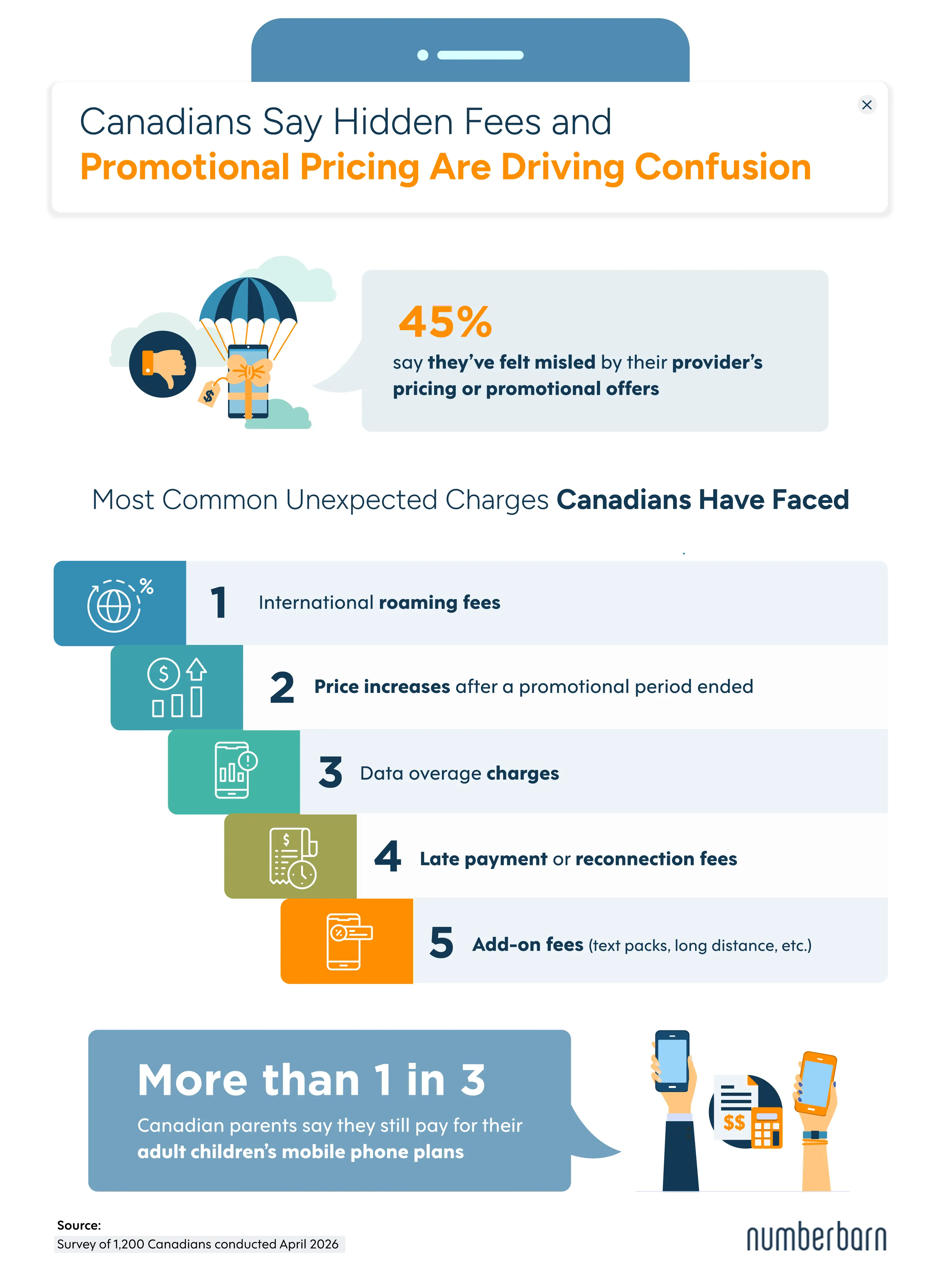
When it comes to monthly phone bills, hidden fees, and unexpected charges are a source of frustration for Canadian consumers.
Among those who reported unexpected costs, the most common include international roaming fees, price increases after a promotional period ends, and data overage charges.
Late payment or reconnection fees and add-on charges, such as long distance or text packages, also ranked among the most frequently cited extras.
These charges can be difficult to anticipate, particularly when plans include promotional pricing or bundled features that change over time.
For many Canadians, that lack of transparency makes it harder to manage monthly costs, and easier for bills to exceed expectations.
The Provinces With the Highest Average Phone Bills in Canada
While many Canadians report rising costs, monthly phone bills also vary across the country.
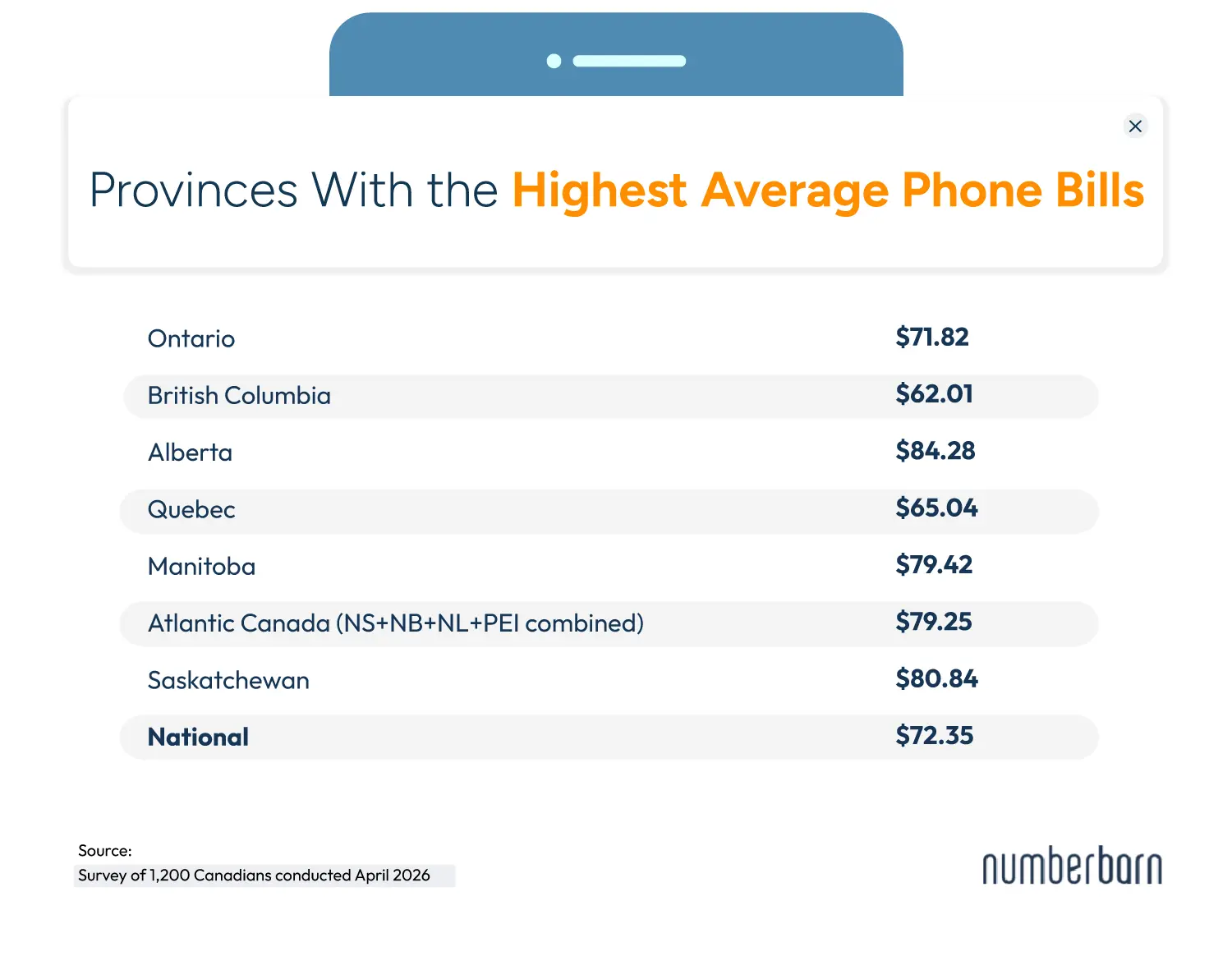
Residents in Alberta report the highest average monthly phone bill at $84.28, followed by Saskatchewan ($80.84), and Manitoba ($79.42). In each of these provinces, average monthly costs are well above the national average of $72.35.
Ontario, the country’s most populous province, falls closer to the national average at $71.82 per month, while British Columbia ($62.01), and Quebec ($65.04) report some of the lowest average monthly costs among larger provinces.
Methodology
In April 2026, NumberBarn surveyed 1,200 Canadian adults to better understand how consumers feel about mobile phone costs, pricing transparency, and affordability.
Respondents were asked a series of questions related to their monthly phone bills, pricing experiences, promotional offers, and perceptions surrounding inflation and telecom costs in Canada.
Demographics
Respondents were required to be at least 18 years old and at least partially responsible for paying or managing their household’s mobile phone plan.
The survey respondents included 52% females, 46% males, and 2% identifying as non-binary/non-conforming. The average age of the respondents was 37 years. Limitations: The survey responses rely on self-reporting, which may be subject to recall bias or social desirability bias.
Additional analysis of wireless pricing trends was conducted using data from Statistics Canada’s Consumer Price Index (CPI), including Cellular Services Price Index data measuring year-over-year changes in mobile phone pricing.
Average monthly phone bill data by province reflects self-reported survey responses from participants across Canada.
Sources: Statistics Canada Consumer Price Index, Canadian Radio-television and Telecommunications Commission Canadian Telecommunications Market Report 2026
Fair Use: Feel free to use this data and research with proper attribution linking to this study.
Illustrations by Daniel Fishel