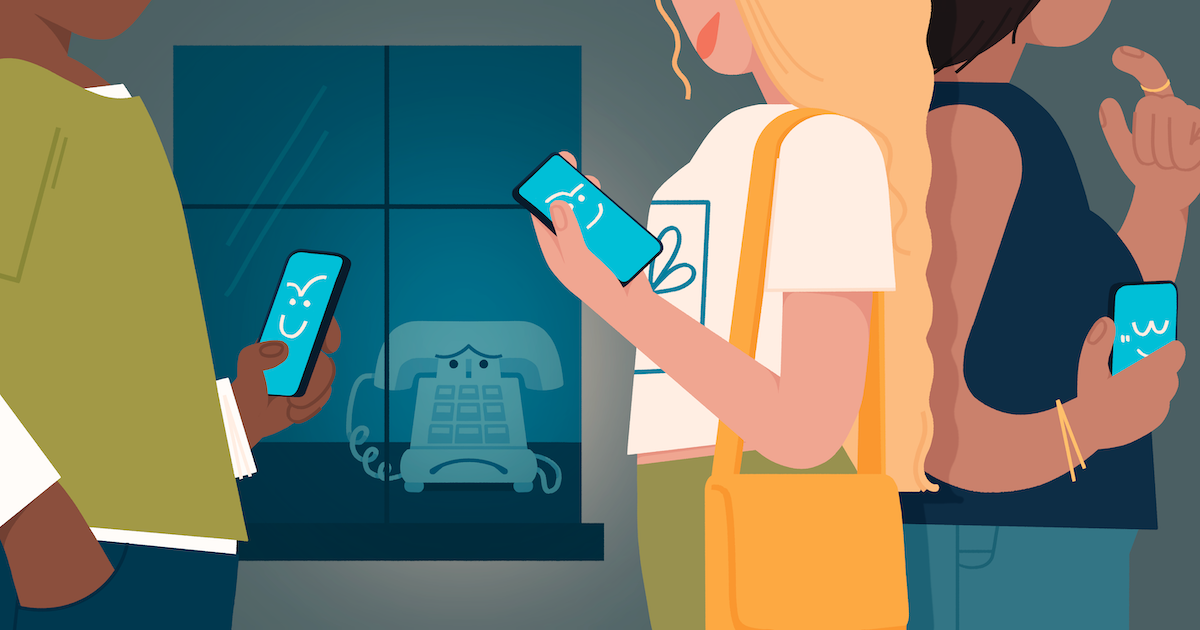

For decades, landline phones were the sound of home.
Today, they’re fading fast.
According to the latest data, 78% of U.S. households are now wireless‑only phone users, up from 71% just one year ago, which means more than 208 million Americans rely solely on mobile phones for voice communication.
Over the past five years, landline phone use has declined by 40.9 million households, and in the last year alone, 6.5 million have cut the landline cord nationwide.

But while landlines are disappearing across the country, they haven’t vanished everywhere, and in some states they’re still surprisingly common.
Whether it’s a sense of nostalgia, reliability, or simply personal preference, it turns out that 55 million Americans are still maintaining a landline!
In this report, NumberBarn breaks down where landlines still exist, how their decline has accelerated, and how Americans feel about this once-universal technology.
- States With the Most Landline Users in 2026
- How Many Americans Still Have a Landline?
- Timeline: When Each State Cut the Landline Cord
- Landline vs. Wireless Phone Users by State
Key Findings
- Nearly 8 in 10 U.S. adults (78%) are wireless-only users, meaning about 208 million Americans now rely exclusively on mobile phones.
- Landline usage has dropped by 40.9 million in just the last five years.
- Northeast residents remain the most loyal to landlines, with 1 in 3 adults (33%) in the region still having a landline phone at home, more than any other part of the country.
- New York is the landline capital of the U.S. with 39.1% of adults living in homes with a landline. Close behind: Massachusetts (38.1%), New Jersey (36.9%), Connecticut (36.7%), and Vermont (36.2%).
- According to our nationwide survey, more than 1 in 4 (27%) respondents said they miss having a landline at home.
- Over two-thirds (68%) still believe landlines are useful.
- Seniors lead in landline use: 40.7% of Americans aged 65+ still have a landline phone at home.
States With the Most Landline Users in 2026
While mobile phones dominate the communication landscape in 2026, nearly 1 in 5 U.S. adults — about 55 million people — still live in households with a landline phone.
And if you live in the Northeast, odds are higher that you’ve still got one plugged in. One-third of adults (33%) in the region say they have a landline at home, making it the most landline-loyal part of the country.
Even in tech-forward California, landlines persist. More than 1 in 5 Californians (21.5%) still rely on a landline, which may be surprising given the state’s reputation as an early adopter of digital trends.
On the other end of the spectrum, residents in states like Idaho, Utah, and Oklahoma are the quickest to cut the cord.
Top 10 States With the Most Landline Phone Users
#1. New York
Percent with landline phones: 39.1%
Total with landline phones: 6,107,603
#2. Massachusetts
Percent with landline phones: 38.1%
Total with landline phones: 2,156,445
#3. New Jersey
Percent with landline phones: 36.9%
Total with landline phones: 2,686,938
#4. Connecticut
Percent with landline phones: 36.7%
Total with landline phones: 1,062,301
#5. Vermont
Percent with landline phones: 36.2%
Total with landline phones: 192,815
#6. New Hampshire
Percent with landline phones: 35.3%
Total with landline phones: 406,423
#7. Delaware
Percent with landline phones: 33.7%
Total with landline phones: 276,328
#8. Maryland
Percent with landline phones: 33.1%
Total with landline phones: 1,595,861
#9. West Virginia
Percent with landline phones: 33.0%
Total with landline phones: 468,082
#10. Rhode Island
Percent with landline phones: 32.9%
Total with landline phones: 293,700
How Many Americans Still Have a Landline?
Today, nearly 8 in 10 U.S. adults (78%) are wireless‑only users, representing more than 208 million Americans who rely exclusively on mobile phones. By comparison, just 55 million adults still live in households with a landline phone, which is a number that has dropped sharply over time.
Landline usage has fallen by 40.9 million households over the past five years, underscoring how quickly Americans are cutting the cord on traditional home phones.
But a quiet cultural comeback may be brewing, especially among younger generations.
Recently, a TikTok trend has emerged of people deliberately incorporating landline phones into their routines as a way to reduce screen time. This landline nostalgia reflected in our nationwide survey, which finds:
- 30% of Gen Z and 28% of Millennials say they miss having a landline at home
- 62% of Gen Z and 54% of Millennials feel nostalgic about landline phones
- About 2 in 3 in both groups say they still believe landlines are useful
Across the board, Americans feel landline phones are still useful. According to our nationwide survey, more than two‑thirds of Americans (68%) believe landline phones are still useful, even if they no longer have one at home. Among those respondents:
- 69% said landlines are more reliable in an emergency
- 68% viewed them as a dependable backup if a mobile phone is lost or stolen
- 65% valued that landlines don’t require batteries or charging
- 46% said landlines appeal because they don’t track location like smartphones
And for some, it’s not just about function, it’s also about familiarity. More than 1 in 4 Americans (27%) said they miss having a landline phone in their home, suggesting that even as wireless usage dominates, the traditional home phone still holds a place in how people think about communication.
Timeline: When Each State Cut the Landline Cord
When it comes to pin-pointing the moment when landline phones began their decline, Idaho was the first state to tip the scale.
Back in 2011-2012, it became the earliest U.S. state where the majority of adults lived in wireless-only households.
From there, the trend spread rapidly. Between 2014 and 2016, wireless phones began to outpace landlines in much of the South and Midwest. During that period, states like the Carolinas, Georgia, Kentucky, Tennessee, Alabama, Arkansas, and Florida all transitioned from majority landline to majority wireless households.
By 2016, wireless-only phone users became the majority nationwide.
These shifts signaled the beginning of the end for traditional home phones in much of the country, and the numbers have continued to drop ever since.
Landline vs. Wireless Phone Users by State
As you might expect, older Americans are the most likely to still have a landline at home. In fact, 40.7% of adults aged 65 and up say their household still uses one, making seniors the age group most likely to hold onto the classic corded connection.
But for younger generations, it’s a different story. Nearly 6 in 10 Gen Z respondents (59%) say they wouldn’t know how to use a rotary phone if handed one, and yet, a surprising 53% of all survey respondents say they still feel nostalgic for landline phones.
Even as landlines fade from daily use, the cultural imprint they’ve left behind is still going strong.
Methodology
This study examines recent trends in telephone usage across the United States, focusing on the prevalence of landline, wireless-only, and phoneless households. Data was analyzed from the Centers for Disease Control and Prevention, National Center for Health Statistics, U.S. Department of Health and Human Services, as well as the U.S. Census Bureau American Community Survey. Our analysis includes the percentage of adults living in households with only wireless telephones (cell phones, or mobile phones), landline phones, and adults without phones (phoneless). These statistics represent the most recent snapshot of nationwide phone use habits and help highlight the sharp decline in landline adoption in recent years.
In January 2026, we also conducted a nationwide survey of 1,006 U.S. adults, aimed at better understanding public attitudes and behaviors around landline phone usage.
Demographics
The survey respondents included 54% females, 44% males, and 2% identifying as non-binary/non-conforming. The average age of the respondents was 41 years. Limitations: The survey responses rely on self-reporting, which may be subject to recall bias or social desirability bias.
Sources: U.S. Census Bureau’s American Community Survey, Centers for Disease Control and Prevention, National Center for Health Statistics, U.S. Department of Health and Human Services
Fair Use: Feel free to use this data and research with proper attribution linking to this study.
Media Inquiries
For media inquiries, contact media@numberbarn.com
Illustrations by Shideh Ghandeharizadeh