If it feels like everyone is switching phone carriers this year… you’re not imagining it. Americans are rethinking their phone plans in 2025 and 2026: comparing prices, weighing network performance and coverage, and trying to make sense of endless “limited-time offers.”
And the major carriers are noticing.
Verizon’s latest earnings report mentions pressure in certain customer segments. AT&T points to similar shifts in its consumer wireless results. T-Mobile continues to see business growth while navigating changes in churn. No drama, just a market in motion.
But earnings only show part of the story.
At NumberBarn, we see something different: the exact moment someone decides it’s time to leave their carrier. Our port-in data doesn’t reveal where people go next and why, but it shows when they make the move. As the largest phone number marketplace, we port thousands of phone numbers a year, giving us a window into a wealth of different phone number and telecom trends.
As from which carriers people port from and when, insights for this study came from seven years of data from confirmed port-ins to NumberBarn between August 2018 and August 2025. This gives us a longer view of how American consumers actually behave when it comes to switching carriers.
- Current Market Conditions: How Major Carriers Are Positioned in 2025
- Which Mobile Carriers Americans Leave Most in 2025 and Historically
- When People Switch Phone Carriers: Key Seasonal Churn Trends
- Long-Term Quarterly Carrier Churn Patterns
- How to Choose a Mobile Carrier in 2025: What to Evaluate Before Switching
- Keeping Your Phone Number When Switching Carriers: How NumberBarn Helps
Current Market Conditions: How Major Carriers Are Positioned in 2025
To understand phone carrier switching trends, it helps to zoom out.
As of Q2 2025, Verizon remains the largest mobile provider in the U.S., holding about 36% of all subscribers. T-Mobile, meanwhile, has grown steadily over the past decade and now serves roughly one-third of the country, and in 2025, it became the U.S. telecom company with the highest market capitalization, at about $308 billion.
That growth comes from long-term moves, including T-Mobile’s acquisition of Sprint and its continued focus on expanding 5G coverage.
In short: the wireless market is changing, competition remains tight, and consumers are paying attention.
Which Mobile Carriers Americans Leave Most in 2025 and Historically
Looking at cumulative port-ins from 2018 to 2025, a clear pattern emerges in NumberBarn’s churn totals. Which carriers do customers leave the most? While the answer is clear, the reasons may be different from a first-glance at the data.
T-Mobile leads total departure volume when legacy MetroPCS and Sprint records are included, followed by Verizon, Sprint, MetroPCS, legacy Cingular (AT&T), AT&T, and US Cellular. These are data points captured when customers move their phone numbers into NumberBarn.
The pattern also aligns with third-party reporting on increased consumer mobility from outlets like TheStreet, Tom’s Guide, and PhoneArena.
To avoid misinterpreting this data, it’s important to note that T-Mobile is the only major carrier that offers no contracts or Early Termination Fees, allowing customers to come and go without penalties or additional fees. This mobile mobility, so to speak, could also influence the reflected data in customer churn.
When People Switch Phone Carriers: Key Seasonal Churn Trends
Here’s where things get interesting: No matter the year, Americans tend to switch carriers around the same times.
NumberBarn’s dataset shows that the months with the highest switching activity are:
- March (#1)
- January (#2)
- December (#3)
These months line up with moments when people naturally reassess their budgets and plans: holiday promotions, new-year resets, and tax-season refunds. We also see smaller bumps in June and midsummer, likely tied to device upgrades and mid-year offers.
Another layer to this story: network performance.
According to J.D. Power’s 2025 U.S. Wireless Network Quality Performance Study, reported network issues (“problems per 100 uses”) rose from 9 PP100 to 11 PP100 in late 2024 as mobile usage surged. A follow-up 2025 study found that network problems then dropped to 8 PP100, the lowest level since 2018, thanks to broader 5G expansion and infrastructure improvements.
These trends don’t explain why customers switch, but they do paint a picture of a wireless landscape that’s constantly transforming alongside customer expectations.
Long-Term Quarterly Carrier Churn Patterns
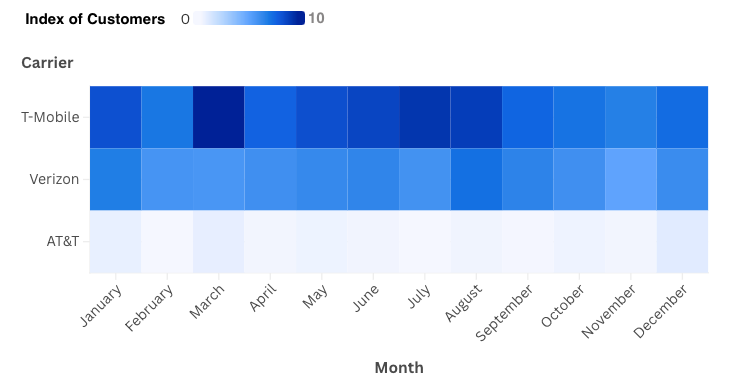
Quarterly trends take us even deeper. Across the 2018–2025 dataset:
- Sprint saw its highest churn in Q1
- T-Mobile peaks in Q3
- Verizon experiences its largest increases in Q4
None of this tells us why someone switches but it does show that carrier changes follow predictable rhythms tied to promotions, device launches, and end-of-year mobile plan re-considerations..
How to Choose a Mobile Carrier in 2025: What to Evaluate Before Switching
Choosing a new mobile carrier doesn’t have to feel overwhelming. Here are three core things to look at before making a move:
1. Check coverage in your area
Coverage can shift dramatically from city to suburb to rural area.
Before committing to a plan, check reliable maps (such as the FCC’s) to confirm that voice, text, and data service actually meet your needs in the places you spend the most time.
2. Look beyond introductory pricing
A deal that looks amazing upfront may look very different a year later. Research from Clark.com shows that many Americans overspend on wireless plans simply because they only consider the promotional rate.
When comparing plans, take a look at:
- The price after the promo ends
- Taxes and regulatory fees
- Device installment costs and commitments
- Hotspot and data limitations
Understanding the full “total cost of ownership” helps avoid bill surprises.
3. Consider MVNOs (Mobile Virtual Network Operators)
MVNOs (like Mint Mobile, Cricket, and others) run on major carrier networks but offer their own pricing and plan structures. Many consumers choose them because they’re versatile, often more affordable, and don’t require long-term contracts.
Studies from Mordor Intelligence, MarketReportAnalytics, and Amdocs show steady growth in MVNO adoption as more customers explore alternatives that better fit their usage patterns.
And if you’re comparing options, tools like number parking or number porting can help you maintain flexibility while you decide.
Keeping Your Phone Number When Switching Carriers: How NumberBarn Helps
Switching carriers shouldn’t mean losing your number… or feeling rushed into a decision.
With NumberBarn, you can:
- Keep your existing number
- Park it temporarily while researching options
- Transfer it when ready
- Purchase a new phone number if needed
These tools give you some breathing room while you look for the right fit. NumberBarn has no contracts or commitments, so you can keep your phone number with NumberBarn as long, or as little, as you need.
You can compare carriers, test an MVNO, or simply pause while you figure out what’s next, all without losing ownership of the number you rely on. If your contract is wrapping up with one carrier, and you’re thinking of moving to a different carrier but waiting on their next big device promotion, etc. you could keep your number with NumberBarn in the interim until the time is right to make your switch.
Choose the wireless experience that works best for you, on your own timeline, without losing the number that keeps you connected.
Takeaways From Mobile Carrier Migration Data
The wireless market is shifting, and consumers are steering the change.
From seasonal switching patterns to evolving network expectations, people are actively reshaping how they manage their mobile plans.
Tools that simplify phone number management (like number parking, number porting, and the option to keep your number when switching carriers) can make those transitions easier, smoother, and far more adaptable in a constantly fluctuating telecom environment.