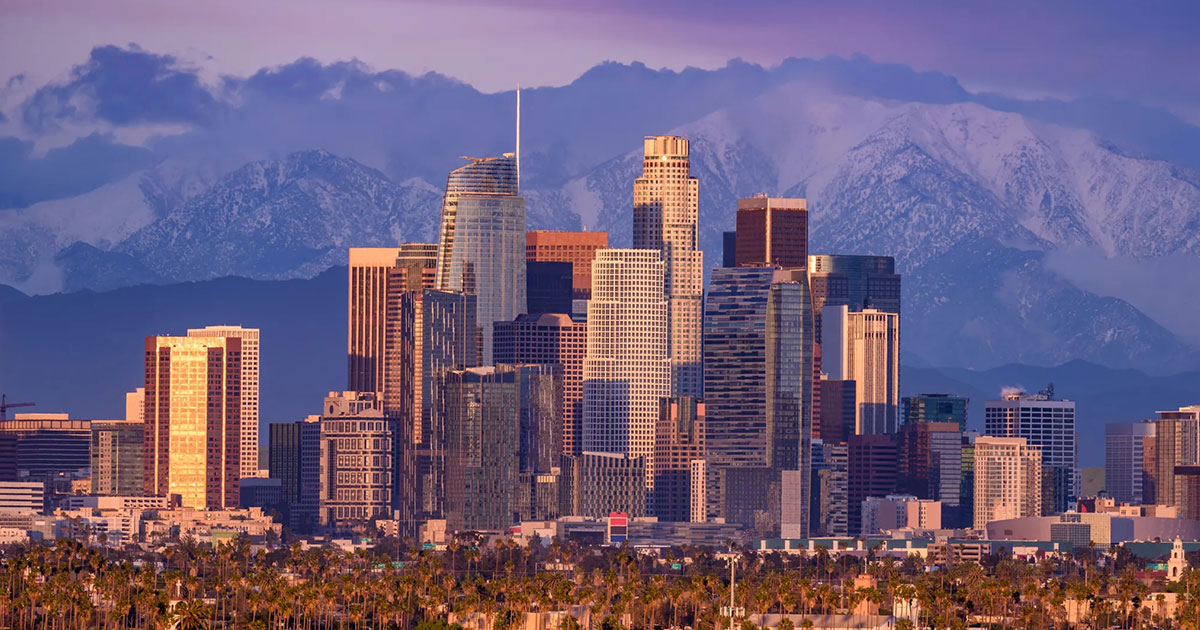

Los Angeles area codes tell a story long before anyone answers the phone. LA has never functioned as a single, neatly contained city, and its phone numbers reflect that reality.
From its earliest days as a “small pueblo” to its growth into a sprawling city made up of many centers, Los Angeles expanded outward through migration, infrastructure, and industry. That expansion is exactly why Los Angeles area codes are so numerous and why multiple LA area codes can exist in the same neighborhood.
So if you tried looking up “What is the Los Angeles area code?”, the answer is… there isn’t just one.
- A Timeline of Los Angeles Area Codes
- Los Angeles Area Codes by Neighborhood
- Why Los Angeles Has So Many Area Codes
- Why Local LA Phone Numbers Still Matter
- How to Get a Los Angeles Phone Number Without Switching Carriers
- Do’s and Don’ts of Choosing an LA Area Code
- Choosing the Right Los Angeles Area Code
A Timeline of Los Angeles Area Codes
Understanding Los Angeles phone numbers starts with knowing when each area code entered the picture. The following timeline is based on records from the California Public Utilities Commission and the North American Numbering Plan Administrator (NANPA):
- 213 (1947): One of California’s original area codes, originally covering all of Los Angeles and much of Southern California.
- 818 (1984): Split from 213 to serve the San Fernando Valley as demand increased.
- 310 (1991): Created from 213 to serve the Westside and South Bay.
- 626 (1997): Split from 818 to serve most of the San Gabriel Valley.
- 323 (1998): Another split from 213, concentrating 213 in Downtown Los Angeles.
- 424 (2006): Added as an overlay to 310, avoiding another disruptive split.
- 747 (2009): Added as an overlay to 818 after public preference against number changes.
- 213/323 Boundary Elimination (2017): Officially merged into a single overlay region.
Translation: LA kept growing, and regulators stopped forcing people to change numbers.
Los Angeles Area Codes by Neighborhood
Today, Los Angeles area codes by neighborhood are defined by regulatory service areas, rather than clean geographic lines. Still, CPUC maps and rate-center data allow clear regional associations.
213 and 323: Central Los Angeles
The 213/323 overlay region serves central Los Angeles and nearby cities, including Downtown LA, parts of Koreatown and Westlake, and surrounding communities such as Pasadena, West Hollywood, Inglewood, and Huntington Park.
- 213: Strongly associated with Downtown Los Angeles and the historic core.
- 323: Widely used across near-central and Eastside areas.
Because the boundary was eliminated, either code can appear in the same neighborhood.
In case you’re wondering, yes, you can buy a 213 area code phone number, or a 323 area code number, or even explore other central LA options.
310 and 424: Westside, South Bay, and Coastal LA
The 310/424 overlay covers much of the Westside, coastal Los Angeles County, and South Bay communities. Common associations include Santa Monica, Venice, Malibu, Beverly Hills, Culver City, Manhattan Beach, and Redondo Beach.
Both codes serve the same geography, and ten-digit dialing is required throughout the region.
818 and 747: San Fernando Valley
The 818/747 overlay serves most of the San Fernando Valley, including North Hollywood, Studio City, Sherman Oaks, Van Nuys, Encino, Reseda, Chatsworth, and Pacoima, along with cities like Burbank and parts of Glendale.
This pairing preserves long-standing Valley identity while expanding number availability.
626: San Gabriel Valley
The 626 area code serves most of the San Gabriel Valley, including Pasadena, Alhambra, Arcadia, San Gabriel, Monrovia, and West Covina.
Created in 1997, it relieved pressure on 818 as population growth accelerated.
Some cities appear in multiple service areas, meaning different phone lines within the same city can legitimately have different area codes.
Why Los Angeles Has So Many Area Codes
Los Angeles grew as a mosaic of districts rather than a single dense core. Downtown, Hollywood, the Westside, the San Fernando Valley, and the San Gabriel Valley each developed under different economic and cultural forces, shaping how the city expanded over time.
As population increased and phone usage surged, California regulators faced ongoing number exhaustion. Early fixes relied on geographic splits, forcing customers to change numbers. Later, the state shifted toward overlays (adding new area codes to the same geographic region) so people could keep their existing numbers.
That’s why area codes for Los Angeles overlap today. It’s not chaos (well, a tad). It’s a compromise.
If you want to explore what’s currently available, you can search from thousands of available LA area code numbers. And, spoiler – if you find one you like, you don’t even have to switch carriers or add an expensive new line to your plan.
Why Local LA Phone Numbers Still Matter
Local or in-state phone numbers can modestly improve call answer rates compared to out-of-state numbers, particularly when caller ID shows geographic familiarity
Having a local LA phone number can prove beneficial for multiple scenarios. If you’ve just moved to LA and want to establish yourself, getting an LA area code phone number can help both your business and your personal life.
Associating your brand with your local area code helps assure customers that you really are “local” and of course the same for sharing your number in public places, dating, etc. And of course, if you’re looking to work “in the industry” in LA, having a local number to share with new contacts could be invaluable.
In short:
- Local Los Angeles phone numbers can reduce friction.
- A local number can boost your local credibility professionally and personally.
- Recognition and familiarity still matter.
How to Get a Los Angeles Phone Number Without Switching Carriers
Getting an LA phone number doesn’t require changing your phone or provider.
With NumberBarn, you can:
- Search an area code number by city or region.
- Choose a local or vanity number.
- Forward calls to your existing phone or port your number if you prefer.
You get a second line on your existing device, helping improve your reputation as an LA local, while not having to change your long-time (potentially out-of-state) phone number or contact info. Your number stays flexible, even if your location changes.
Do’s and Don’ts of Choosing an LA Area Code
Do:
- Choose an area code your audience recognizes.
- Understand that overlays mean multiple valid codes per neighborhood.
- Plan for future growth.
Don’t:
- Assume there’s one “true” Los Angeles area code.
- Misrepresent your location.
- Overcomplicate your call setup. Use tools like call forwarding to keep it simple.
Choosing the Right Los Angeles Area Code
Los Angeles area codes reflect the city itself: layered, expansive, and constantly evolving. From the legacy of 213 to modern overlays like 424 and 747,LA area codes bring lots of options, and you can even get creative with repeating digits or custom spellings for your new LA area code phone number.
When you’re ready, you can search an area code number and find a Los Angeles phone number that fits, without changing how you already communicate.