
The Generational Phone Divide: Gen Z vs. Millennials
Millennials grew up leaving voicemails. Gen Z grew up leaving people on read.
But despite the stereotypes, the way the two generations use their phones may be more similar than expected.
Including screening unknown calls and using AI to write personal text messages, younger Americans are developing new rules around when, how, and even whether they want to communicate.
To understand how those habits differ, NumberBarn surveyed more than 1,200 Gen Z (ages 18-29) and Millennial (ages 30-45) Americans about their relationships with their smartphones, including questions about screen time, phone calls, texting, AI-assisted communication, privacy, ghosting, and digital detox habits.
Key Findings
- Nearly 8 in 10 of both Millennials (79%) and Gen Z (73%) say they have a healthy or mostly healthy relationship with their phone.
- At the same time, 64% of Millennials and 69% of Gen Z admit they spend too much time on it.
- Nearly 3 in 10 Gen Z respondents (29%) spend eight hours or more per day on their phones.
- Eight in 10 Gen Zers feel anxious when an unknown number calls, compared to roughly seven in 10 Millennials.
- About 1 in 3 of both Gen Zers (35%) and Millennials (33%) have used AI to help write or respond to a personal text message.
- Half of Millennials and 48% of Gen Z have taken a break from their phone or social media, but most eventually returned to their previous habits.
Phone Health
Gen Z and Millennials Think Their Phone Habits Are Healthier Than They Are
Gen Z Tie Millennials
Most Gen Zers and Millennials believe they have a healthy relationship with their phone, but their own habits tell a slightly different story.
Nearly 8 in 10 Millennials (79%) say their relationship with their smartphone is “healthy” or “mostly healthy”, compared with 73% of Gen Z.
Yet 64% of Millennials and 69% of Gen Z also admit they spend too much time on their phones.
This contradiction remains even among respondents who gave themselves the highest marks in phone health. Specifically among those who said they have a “healthy” relationship with their smartphone, 56% of Millennials and 58% of Gen Z still say they spend too much time on it.
[Gen Z appears slightly more critical of its own phone habits. Just 22% describe their relationship with their smartphone as fully healthy, compared with 30% of Millennials. Meanwhile, 27% of Gen Z say their relationship is mostly unhealthy or unhealthy, compared with 21% of Millennials.]
How Much Time Do Gen Z and Millennials Actually Spend on Their Phones?
Gen Z Tie Millennials
When asked to check their actual screen time, both generations are spending more than six hours per day on their smartphones.
Gen Z averages 6.6 hours of daily screen time, slightly higher than the 6.3 hours reported by Millennials. Nearly 3 in 10 Gen Zers (29%) spend eight hours or more on their phones each day, compared with 24% of Millennials.
But one of the more revealing findings is how those numbers compare with what respondents thought their screen time would be.
Before checking their phone settings, respondents were asked to estimate their average daily screen time. Gen Z estimated an average of 6.1 hours per day, about 30 minutes less than their actual usage. Millennials estimated 5.6 hours, underestimating their actual screen time by roughly 40 minutes per day.
Over the course of a week, that gap adds up. Gen Z underestimates its smartphone use by roughly 3.5 hours per week, while Millennials underestimate theirs by nearly five hours.
Despite spending slightly less time on their phones, Millennials appear to have a harder time accurately gauging just how much time they’re actually online.
Gen Z and Millennials Are Taking Digital Detox Breaks, But Most Don’t Stick
Awareness of excessive screen time is also translating into attempts to unplug.
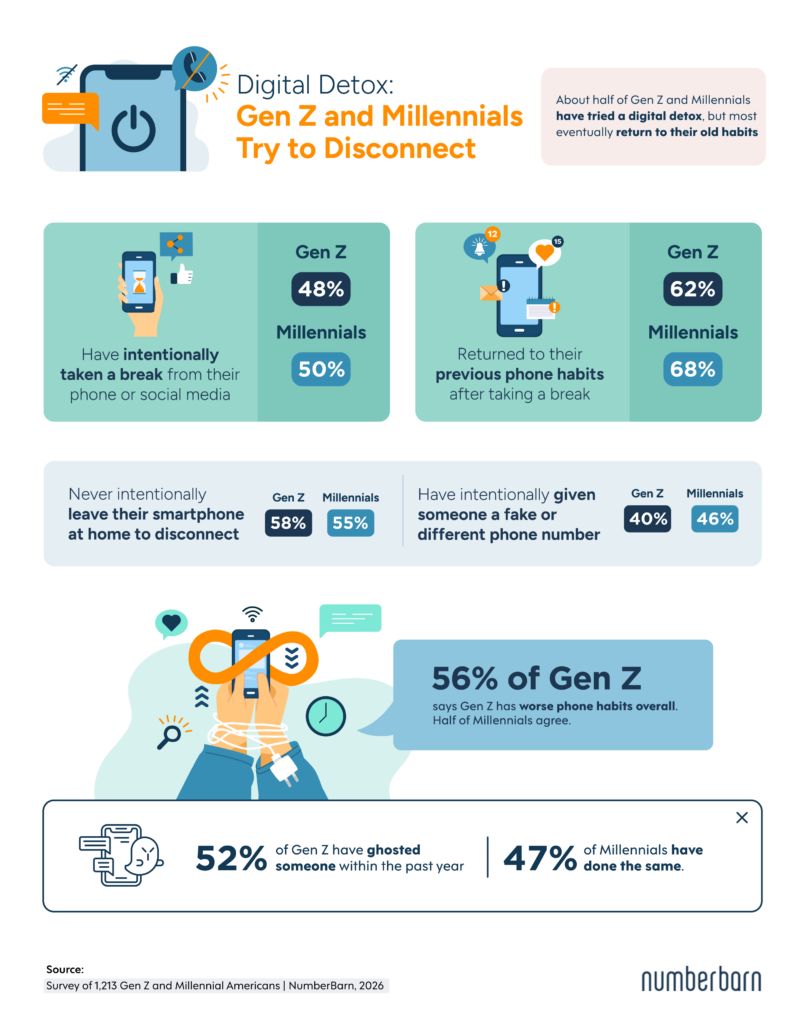
Half of Millennials (50%) and nearly half of Gen Z (48%) say they’ve intentionally taken a break from their smartphone or social media within the past year to reduce their screen time or improve their well-being. Another 27% of Gen Z and 25% of Millennials say they’ve considered doing so.
The harder part appears to be making those changes stick. Among respondents who took a digital break, 68% of Millennials and 62% of Gen Z say they eventually returned to their previous phone habits.
Communication
Gen Z and Millennials Would Rather You Text
Gen Z > slightly Millennials
Gen Z and Millennials may spend hours each day on their phones, but that doesn’t mean they want you to call them.
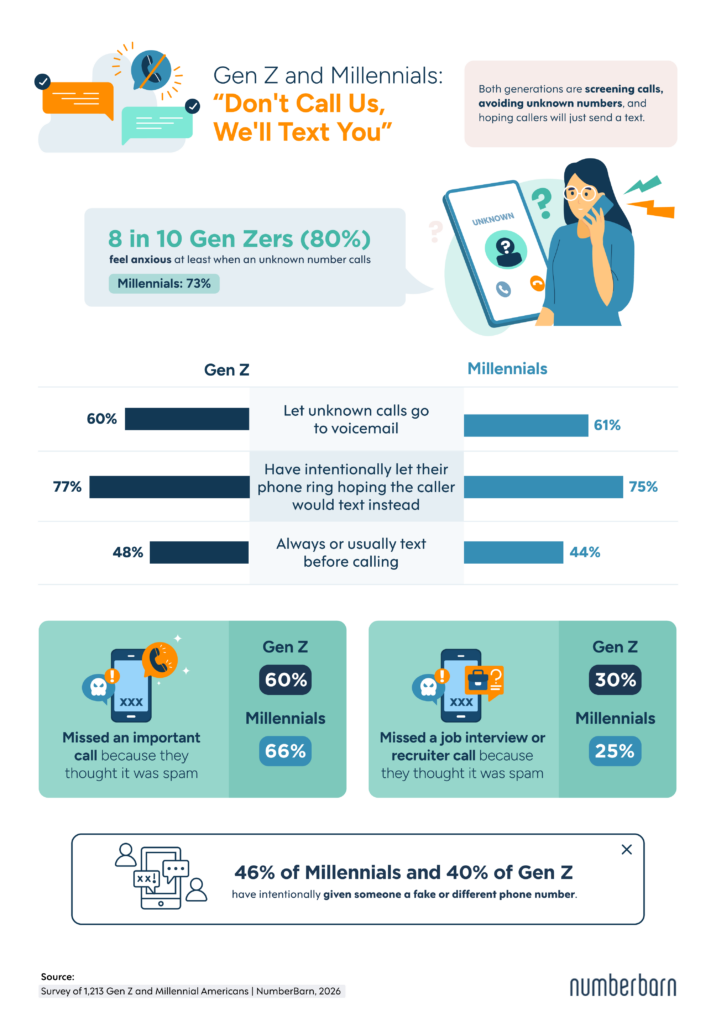
Eight in 10 Gen Zers (80%) say they feel anxious at least “sometimes” when an unknown number calls, compared with 73% of Millennials.
When an unfamiliar number does appear on their screen, roughly 6 in 10 respondents from both generations typically let the call go to voicemail rather than answer it.
Even calls from people they do know don’t always get picked up. Three-quarters of respondents admit they’ve intentionally let their phone ring because they hoped the caller would send a text instead, including 77% of Gen Z and 75% of Millennials.
That preference for screening calls can also have consequences, considering nearly two-thirds of Millennials (66%) and 60% of Gen Z say they’ve missed an important phone call because they assumed it was spam.
The problem also extends into the workplace and job search. According to respondents, a surprisingly high 3 in 10 Gen Zers (30%) and 1 in 4 Millennials (25%) say they’ve missed a job interview or recruiter call because they thought it was spam.
Is Calling Without Texting First the New Phone Faux Pas?
Gen Z Tie Millennials
Both generations are also rewriting some of the unwritten rules around when it’s acceptable to call.
Nearly half of Gen Z (48%) say they “always” or “usually” text someone before calling, compared to 44% of Millennials. And when the phone does ring, three-quarters of Millennials (75%) and 77% of Gen Z admit they’ve intentionally let it ring because they hoped the caller would just text instead.
Voice memos get a mixed reception. Half of Millennials and 49% of Gen Z say they find voice memos annoying at least sometimes. Millennials are more likely to dislike them outright, with 19% saying they find voice memos annoying, compared to just 11% of Gen Z.
1 in 3 Gen Zers and Millennials Use AI to Write Personal Texts
Gen Z > slightly Millennials
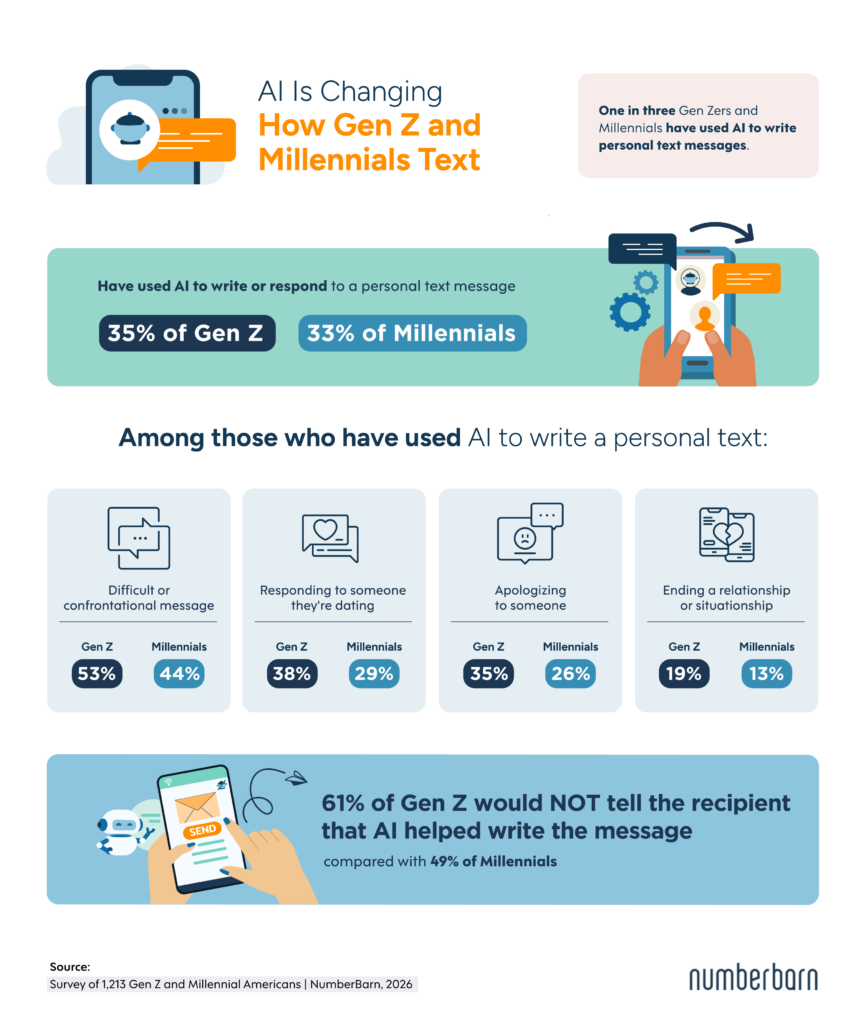
AI is increasingly making its way into personal conversations, including apologies, difficult messages, dating, and even breakups.
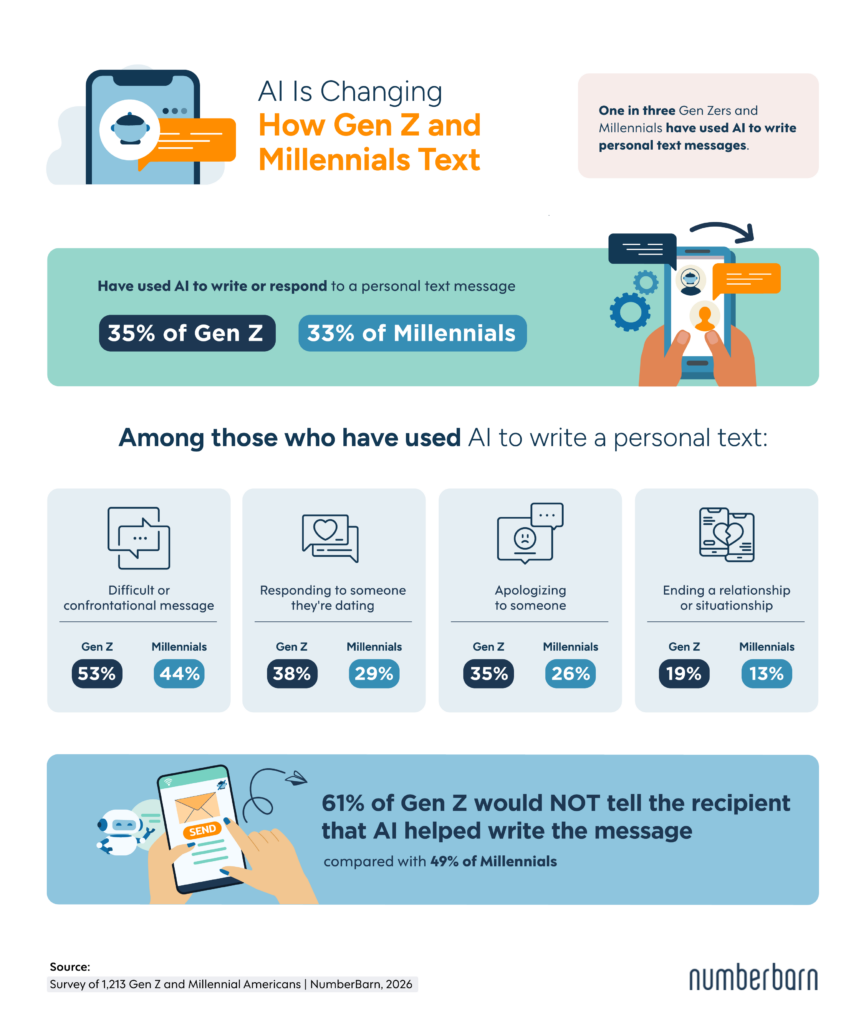
More than one-third of Gen Z (35%) and one-third of Millennials (33%) say they’ve used AI to help write or respond to a text message to someone they know personally. Despite Gen Z’s reputation as the more AI-native generation, overall usage was nearly identical between the two age groups.
What they’re asking AI to write, however, reveals some differences.
Among AI users, Gen Zers lean slightly more reliant on AI for difficult social events. Gen Z was more likely to turn to AI for difficult or confrontational conversations (53% vs. 44%), responding to someone they were dating or interested in dating (38% vs. 29%), and ending a romantic relationship or situationship (19% vs. 13%).
Both generations are also using AI to navigate other uncomfortable conversations, including apologizing, declining invitations, reconnecting with someone they’ve lost touch with, and responding to conflicts with friends or family.
Yet Gen Z Is Less Likely to Admit AI Helped Write the Text
Gen Z > Millennials
Using AI to craft a message is one thing but telling the person on the other end is another.
Among those who’ve used AI for personal texts, 61% of Gen Z say they would not tell the recipient that AI helped write the message, compared with 49% of Millennials.
AI isn’t just changing how younger Americans work or search for information, it’s also becoming part of how they navigate the conversations they may not know how, or simply don’t want, to write themselves.
Younger Americans Are More Protective of Their Phone Numbers
Gen Z > slightly Millennials
For Gen Z and Millennials, sharing a phone number doesn’t necessarily mean sharing their real phone number.
Nearly half of Millennials (46%) and 40% of Gen Z say they’ve intentionally given someone a different or fake phone number. The most common reasons include a lack of romantic interest, privacy concerns, not wanting to say no directly, and feeling unsafe.
Even those who share their real number don’t always feel good about it afterward.
Nearly three-quarters of Millennials (72%) and 65% of Gen Z say they’ve regretted giving their personal phone number to someone. Coworkers and dating partners were among the most common people respondents later wished they hadn’t shared their number with.
3 in 10 Millennials (30%) and 26% of Gen Z currently use more than one phone number, most commonly for work, privacy, or business purposes. Another 18% of Millennials and 13% of Gen Z use two separate phones to keep different parts of their lives apart.
There’s also some detective work happening after numbers are exchanged. Nearly half of Millennials (47%) and 44% of Gen Z admit they’ve searched someone’s phone number online after receiving it.
Which Generation Thinks They Have the Worst Phone Habits?
Gen Z > Millennials
When asked to settle the debate themselves, both generations largely pointed in the same direction: Gen Z.
More than half of Gen Z respondents (56%) say their own generation has worse phone habits overall. Half of Millennials agree. (Another 36% of Millennials and 34% of Gen Z say both generations are equally bad.)
Still, there are a few etiquette rules both generations still agree on. More than 8 in 10 Millennials (86%) and Gen Zers (81%) say using speakerphone in public is unacceptable.
Ghosting is a little more divided. Just over half of Gen Z (52%) say they’ve intentionally stopped responding to someone’s calls or texts within the past year, compared with 47% of Millennials. However, Gen Z is also more likely to say they’re ghosting less than they were a year ago, 29% compared with 21% of Millennials.
Overall
Ultimately, the differences between the generations aren’t always as dramatic as the stereotypes suggest. Both spend hours a day on their phones, screen unknown calls, use AI to navigate personal conversations, struggle to make digital detoxes stick, and admit their relationship with their smartphone could use some work.
Gen Z may spend slightly more time on their phone, but if there’s one area where they have an edge, it may be self-awareness. They’re the generation most likely to admit that their own phone habits can cause themselves problems.
Methodology
In July 2026, NumberBarn surveyed 1,213 Americans to better understand generational differences in smartphone habits, phone number privacy, screen time, communication preferences, and attitudes toward AI in personal messaging. The survey was conducted among two distinct generational cohorts: 607 Gen Z respondents (ages 18-29) and 606 Millennial respondents (ages 30-45).
Respondents answered a series of questions about their daily screen time and self-awareness around usage, phone number privacy behaviors, call and texting habits, smartphone dependency, digital detox behaviors, and perceptions of AI in personal communication.
Demographics
Gen Z: Ages 18-29, average age 25. Gender: 57% female, 39% male, and 4% identified as non-binary, transgender, or another gender identity. Relationship status: 46% single, 32% in a relationship but not married, 21% married.
Millennial: Ages 30-45, average age 37. Gender: 53% female, 45% male, and 2% identified as non-binary, transgender, or another gender identity. Relationship status: 51% married, 28% single, 17% in a relationship but not married, 4% divorced or separated.
Combined: 55% female, 42% male, and 3% non-binary, transgender, or another gender identity. Average age: 31. Respondents represented all 50 states.
Fair Use
When using this data and research, please attribute by linking to this study and citing https://www.numberbarn.com.
Media Inquiries
For media inquiries, contact media@numberbarn.com