
- America’s Most Unreachable Cities
- America’s Most Unread Texts and Ignored Calls
- Cities With the Most Unread Text Messages
- Cities Declining the Most Phone Calls
- America’s Phone Habits, by the Numbers
Despite feeling constantly connected, Americans are routinely letting calls go to voicemail, leaving text messages on read, or ignoring incoming calls altogether. Meanwhile, spam calls, robocalls, and promotional texts have made people more selective about who they answer and when they respond.
In order to understand how phone avoidant people truly are, NumberBarn surveyed Americans across the 30 largest metropolitan areas about their phone and text messaging behaviors.
We surveyed Americans on all things ghosting: call screening, text response times, phone anxiety, unread messages, and the impact spam calls have on everyday communication.
Key Findings
- Los Angeles ranks as America’s most unreachable city, followed by Cleveland and Seattle. Meanwhile, Austin ranks as the nation’s most reachable city.
- 86% of respondents say spam and robocalls have made them less likely to answer their phone.
- 61% of surveyed respondents say they let phone calls go to voicemail “often” or “always.” Just 2% say they always answer calls from unknown numbers.
- Nearly half of Americans surveyed (47%) admit to screening calls from people they know, including friends, family members, and coworkers.
- Two-thirds of respondents (66%) say they intentionally delay responding to text messages, while 39% admit to leaving messages on read without replying.
- 46% of respondents say they have been told they are “hard to reach” within the past year, including a majority (56%) of Gen Z respondents.
America’s Most Unreachable Cities
Ignoring calls. Leaving messages unread. Letting texts sit unanswered for hours or even days.
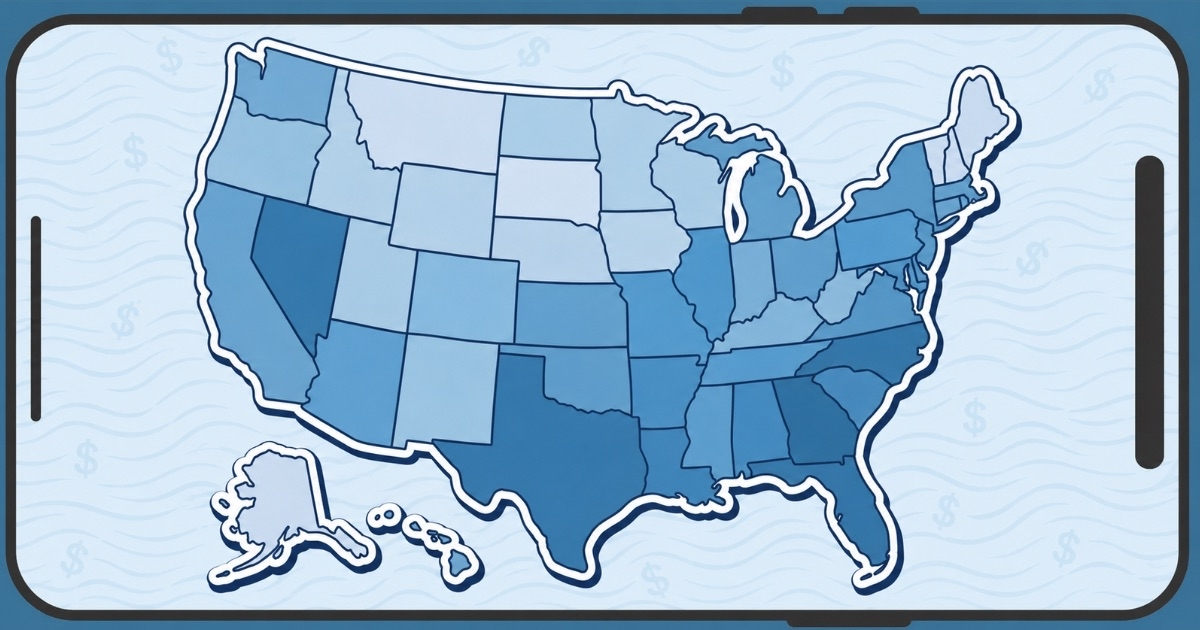
Behaviors like these have become the norm as Americans navigate a constant stream of notifications, spam calls, and digital communication. According to our survey, Los Angeles ranks as the most unreachable city in America, followed by Cleveland and Seattle.
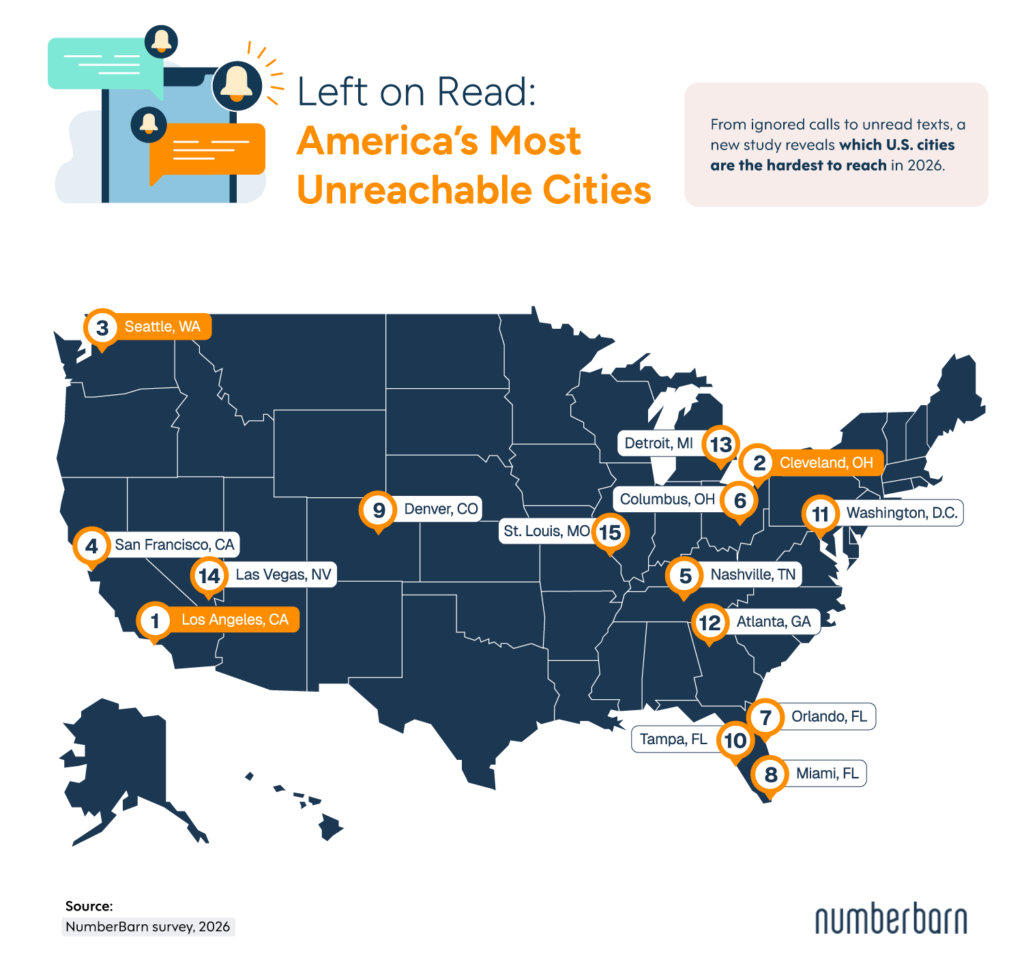
What makes Los Angeles the nation’s most unreachable city? More than 1 in 10 Los Angeles respondents say it typically takes them a day or longer to respond to a text message, while 22% say they often or always ignore calls from someone they know. Nearly half (46%) report being told they are “difficult to reach.”
Seattle’s placement near the top may reinforce the city’s “Seattle Freeze” reputation, while Cleveland’s ranking at No. 2 stands out as one of the study’s biggest surprises.
Meanwhile, New York finished 26th overall, challenging the stereotype that New Yorkers are difficult to reach.
Seattle residents report similar communication habits, with one in five respondents saying they often or always ignore calls from people they know, while 57% say they have been told they are “difficult to reach.”
Coming in at No. 2 is Cleveland, which also posted one of the highest rates of residents being labeled “difficult to reach.”
Austin ranks as the nation’s most reachable city, with Dallas and Houston also finishing among the easiest cities to contact.
America’s Most Unread Texts and Ignored Calls
For many Americans, text message response time can range from immediate response to taking days or more to respond. Sometimes, it means messages never get opened and phone calls that never get answered at all.
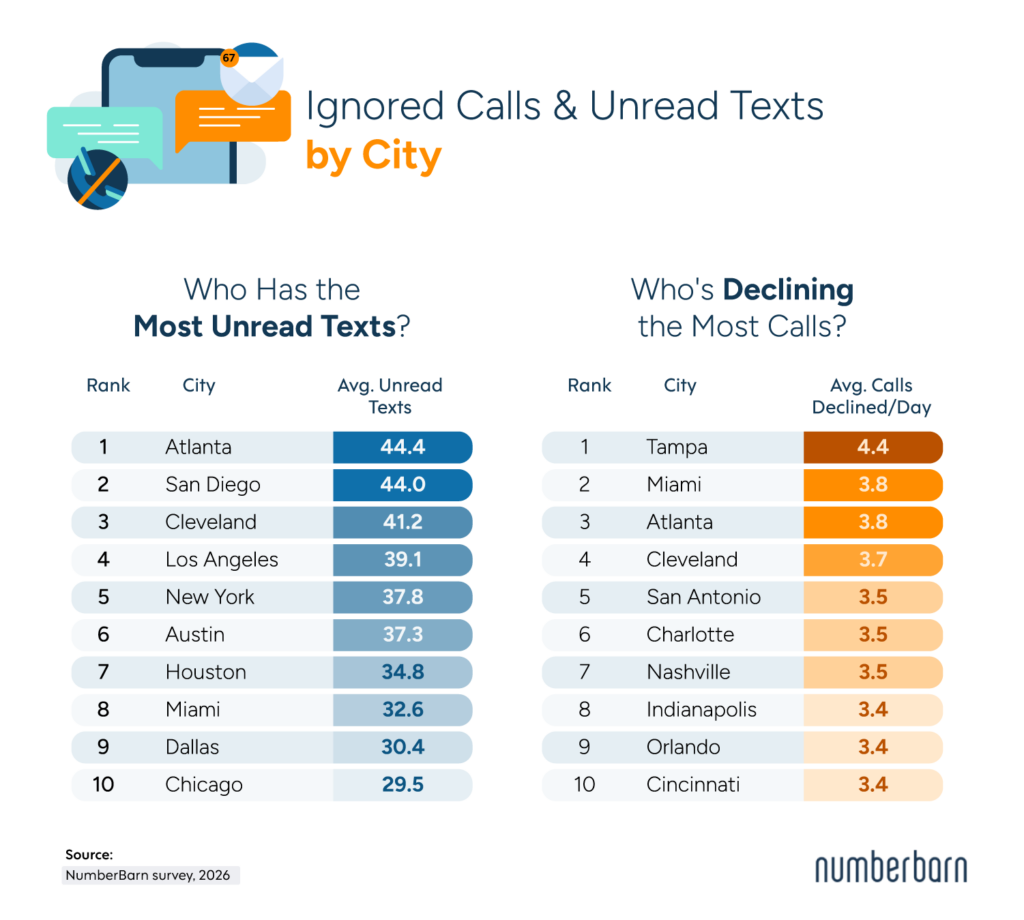
Nationally, respondents report having an average of 24.7 unread text messages sitting in their inbox at any given time. (This spans all types of messages and calls, ranging from spam and MFA, to personal calls, and includes texts from family and friends.)
People also reported declining an average of 3.1 phone calls per day, highlighting how common it has become to screen calls.
Cities With the Most Unread Text Messages
Atlanta tops the nation for unread texts, with residents reporting an average of 44.4 unread messages, which is nearly double the national average. San Diego and Cleveland follow closely behind, while Los Angeles and New York also rank among the nation’s biggest accumulators of unanswered messages.
While some unread messages may come from friends and family, respondents noted most were due to two-factor authentication codes, delivery notifications, appointment reminders, promotional texts, and automated alerts.
Cities Declining the Most Phone Calls
As spam calls, robocalls, and unwanted outreach continue to rise, many people have adopted a “screen first, answer later” approach to communication.
Tampa residents decline more calls than anyone else in America, rejecting an average of 4.4 calls per day.
In a previous NumberBarn study examining robocall complaints, St. Petersburg ranked second nationally for robocalls per capita, while Tampa also ranked among the most affected metro areas. While the two studies measure different behaviors, the overlap suggests that persistent robocalls may be contributing to declining trust in phone communication and a greater tendency to screen incoming calls.
America’s Phone Habits, by the Numbers
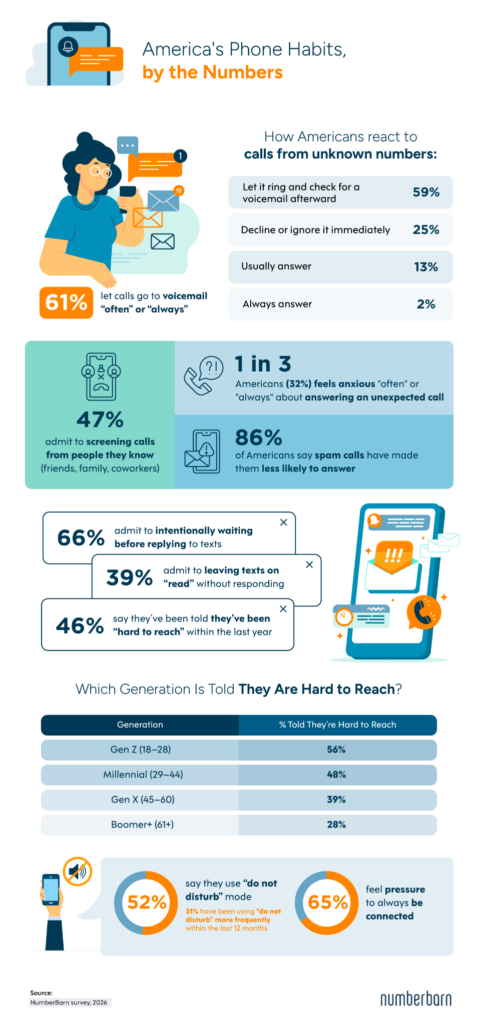
From unread messages to Do Not Disturb mode, Americans are selective about who they answer, when they respond, and how available they want to be.
An overwhelming 86% of Americans say spam calls and robocalls have made them less likely to answer their phone, which may explain why nearly 61% say they let calls go to voicemail “often” or “always.”
According to respondents, most Americans either let the call ring and check for a voicemail afterward (59%) or ignore the call entirely (25%).
Outside of screening spam calls, nearly half of respondents (47%) admit they screen calls from people they know, including friends, family members, and coworkers.
Two-thirds of Americans (66%) admit they intentionally wait before responding to texts, while 39% say they have left a message on “read” without replying. Nearly half (46%) say someone has told them they were difficult to reach within the last year.
More than half of Gen Z respondents (56%) say they have been told they are difficult to reach, compared to 48% of Millennials, 39% of Gen X, and just 28% of Baby Boomers.
Many respondents appear to be setting stronger boundaries around their availability.
More than half (52%) say they use Do Not Disturb mode, while 31% report using it more frequently than they did a year ago. Despite those efforts, 65% say they still feel pressure to always be connected.
As methods of communication continue to evolve, communication habits are also changing. Americans have more ways to reach one another than ever before, yet many are becoming increasingly difficult to contact.
Methodology
In May 2026, NumberBarn surveyed 1,501 American residents across the 30 largest metropolitan areas in the country. Respondents were asked about their phone and text messaging behaviors, including how frequently they screen calls, delay responding to messages, use Do Not Disturb mode, and how spam and robocalls have affected their communication habits.
To rank each city, we developed a composite Unreachability Index using four weighted categories: Call Avoidance (35%), Text and Message Response (35%), Phone Habits (20%), and Spam and Trust Erosion (10%). Each category was scored on a normalized 0-100 scale, with higher scores indicating less reachable communication behavior. The weighted scores were combined to produce each city’s overall index score.
For open-ended numeric questions, including unread text messages and calls declined per day, we identified and excluded outliers using the Interquartile Range (IQR) method, ensuring that extreme responses did not skew city-level averages.
Demographics: The survey respondents included 53% females, 45% males, and 2% identifying as non-binary/non-conforming. The average age of respondents was 39 years.
Limitations: Survey responses rely on self-reporting, which may be subject to recall bias or social desirability bias.
Sources: U.S. Census Bureau American Community Survey; Pew Research Center
Fair Use: When using this data and research, please attribute by linking to this study and citing https://www.numberbarn.com.
Media Inquiries: For media inquiries, contact media@numberbarn.com
Illustrations by Daniel Fishel