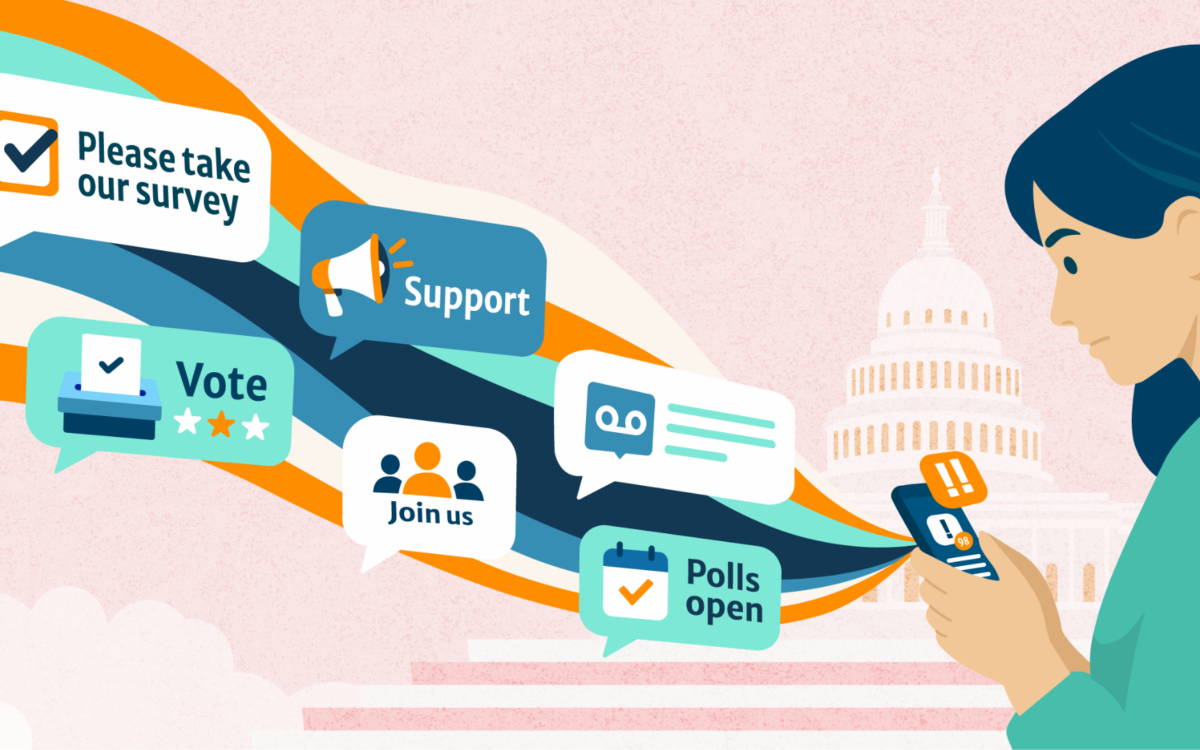

Election season comes with campaign ads, yard signs, debates, and increasingly, a steady stream of political calls and text messages.
But are political calls and texts actually working?
To find out, NumberBarn conducted a nationwide survey of U.S. adults about the political calls and texts they receive, exploring recipient sentiment, what recipients do to avoid political messages, whether the messages influence their views or voting behavior, and how they feel about AI-generated political communication.
Key Findings
- Americans receive an estimated 13 political calls and texts in a typical week, or roughly two per day.
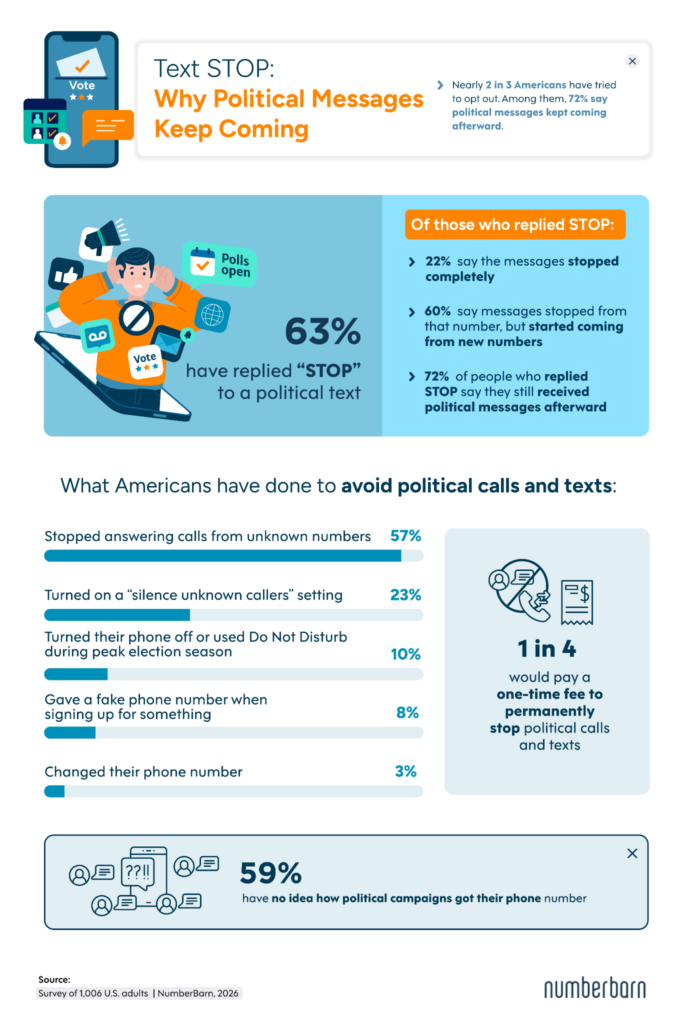
- 72% of respondents who replied “STOP” say they still received political messages afterward.
- Four in 10 (40%) expressed annoyance by the very first political call or text they receive.
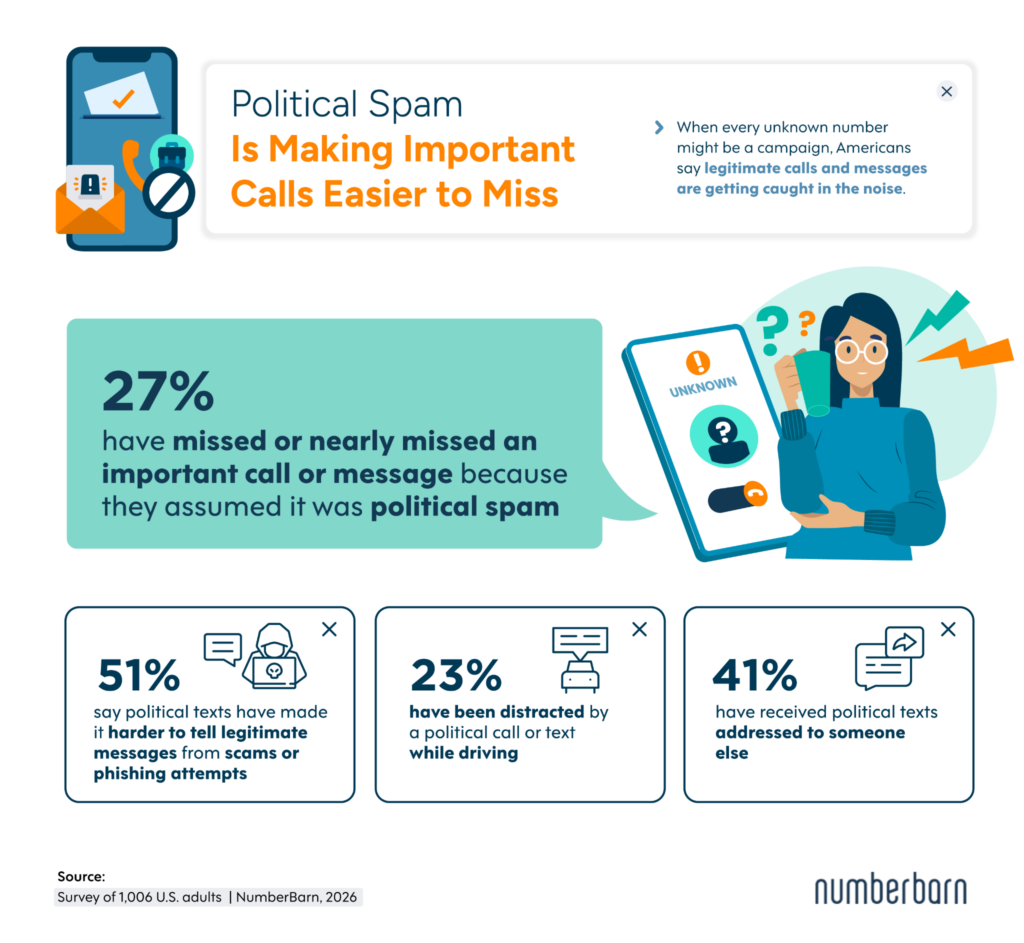
- 51% say political texts have made it harder to distinguish between legitimate messages and scams or phishing attempts.
- More than 8 in 10 (86%) believe campaigns should be required to disclose AI-generated political messages.
- Nearly one-third (32%) of respondents did not correctly identify the date of the 2026 midterm election.
How Many Political Calls and Texts Are Americans Getting?
Political texts are a regular part of election season for most Americans, but perceptions of them are evolving in new ways.
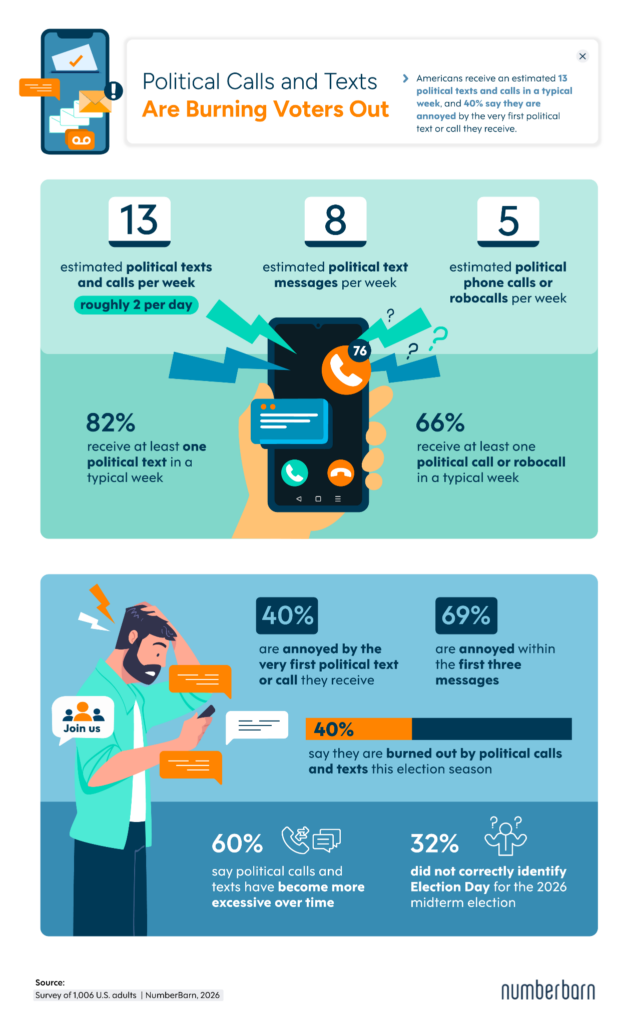
According to respondents, Americans receive an average of 13 political calls and text messages in a typical week, or nearly two per day. That includes about eight political texts and five calls or robocalls per week.
“…just 3% [of respondents] said [political texts] made them view a candidate more favorably.”
More than 8 in 10 Americans (82%) say they receive at least one political text during a typical week, while two-thirds (66%) receive at least one political call or robocall.
And for many, the volume feels like it is getting worse. Six in 10 Americans (60%) say political calls and texts have become more excessive over time.
That growing volume may also explain why frustration is on the rise, especially when 4 in 10 respondents say they are annoyed by the very first political call or text they receive.
Do Political Texts Stop After You Reply “STOP”?
For many Americans, replying “STOP” does not appear to end political outreach altogether.
Nearly two-thirds of respondents (63%) say they have replied “STOP” to a political text. Among them, just 22% say the messages stopped completely. Another 60% say messages stopped from that number but began arriving from new ones, while 12% say the messages continued.
Americans are also taking other steps to avoid political calls and texts. More than half (57%) say they have stopped answering calls from unknown numbers, while 23% have turned on a “silence unknown callers” setting. Another 10% have used Do Not Disturb during peak election season, 8% have given out a fake phone number, and 3% have changed their phone number entirely. Previous NumberBarn research has also explored how Americans are responding to unwanted robocalls and spam calls throughout the year.
More than 1 in 4 Americans (26%) say they would even pay a one-time fee to permanently block political calls and texts. And despite all that outreach, 59% say they have no idea how political campaigns got their phone number in the first place.
For consumers looking to understand their options, the FCC provides guidance on political campaign robocalls, including how to report unwanted messages.
How Quickly Do Americans Get Burned Out by Political Calls and Texts?
It doesn’t take much for political outreach to wear people down.
Four in 10 Americans (40%) say their annoyance begins by the very first political call or text they receive, while 69% became annoyed within the first three messages. Another 40% say they are already feeling burned out by political calls and texts this election season.
Respondents say the frustration with political calls and texts has been building throughout the years. Six in 10 Americans (60%) say political calls and texts have become more excessive compared with past elections.
Are Political Calls and Texts Causing Americans to Miss Important Messages?
Political spam may be creating other problems beyond simple annoyance and frustration.
More than 1 in 4 Americans (27%) say they have missed or nearly missed an important call or message because they assumed it was political spam. Among those respondents, the most common missed communications involved family or friends (43%), healthcare providers (41%), and work or job opportunities (37%).
“…nearly one-third of respondents (32%) could not correctly identify the date of the 2026 midterm election, which is Tuesday, November 3, 2026.”
Political messaging may also be making legitimate communication harder to trust. More than half of Americans (51%) say political texts have made it harder to tell real messages from scams or phishing attempts.
Another 23% say a political call or text has distracted them while driving, while 41% have received political texts addressed to someone else.
Do Political Calls and Texts Actually Influence Voters?
For most Americans, political calls and texts do not appear to change minds in a positive way.
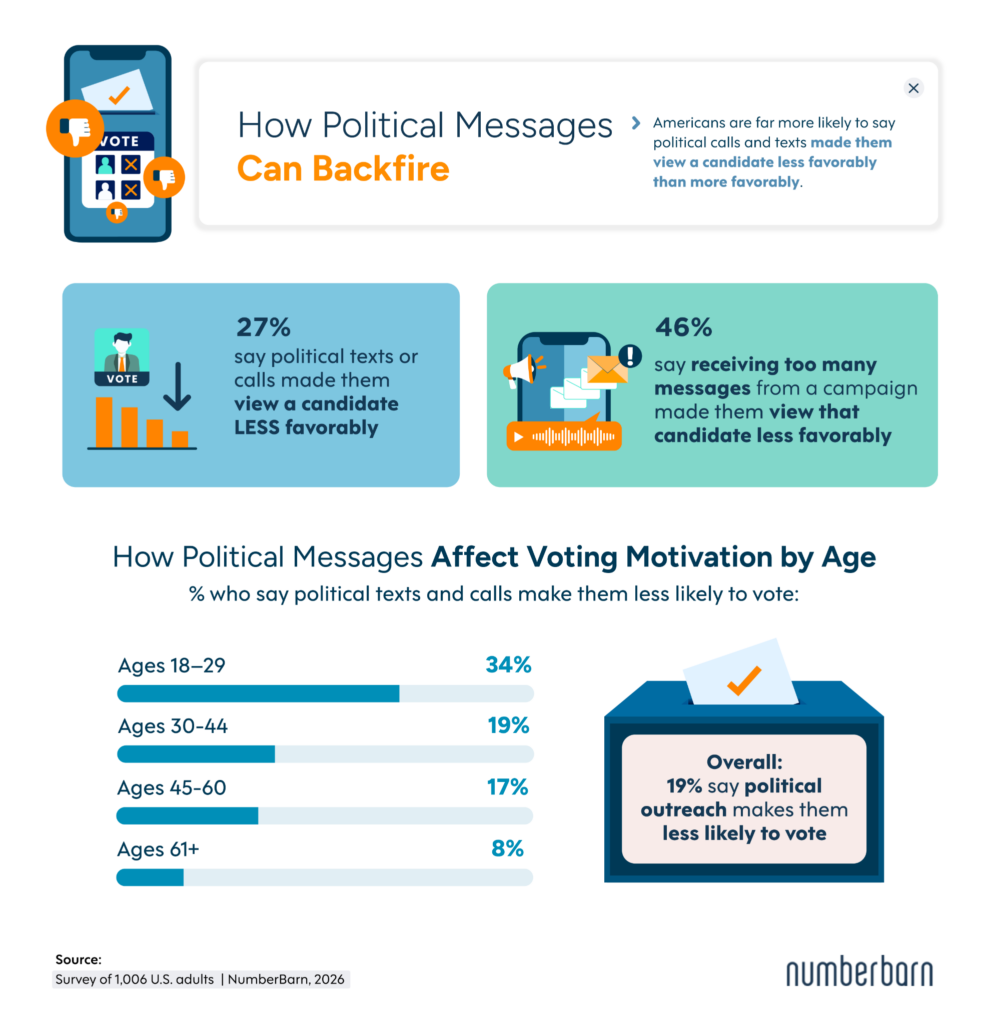
More than 1 in 4 respondents (27%) say a political call or text has made them view a candidate less favorably, compared with just 3% who say one made them view a candidate more favorably.
Political messages may have an effect on voter motivation. More than one-third (34%) of respondents aged 18-29 say that political calls and texts made them less likely to vote at all.
Overall, 19% of all respondents say that political calls and texts make them less likely to vote, compared with just 5% who say they make them more likely.
Nearly one-third of respondents (32%) could not correctly identify the date of the 2026 midterm election, which is Tuesday, November 3, 2026.
Can Too Many Political Messages Backfire on Candidates?
For some Americans, the problem is not political outreach itself, but how often it happens.
Nearly half of respondents (46%) say receiving too many calls or texts from a campaign has made them view that candidate less favorably.
“More than 8 in 10 Americans (86%) say political campaigns should be legally required to disclose when a text, call, or voice message was created using AI.”
When asked what campaigns should do differently, more than half (51%) say political texts should only be sent to people who opted in first. Another 20% say campaigns should send far fewer messages.
Even when political outreach is intended to inform or motivate, too many messages can leave some Americans with a more negative impression instead.
Can Americans Tell When Political Messages Are AI-Generated?
AI is also becoming part of political outreach, but Americans are not especially confident they can always recognize it.
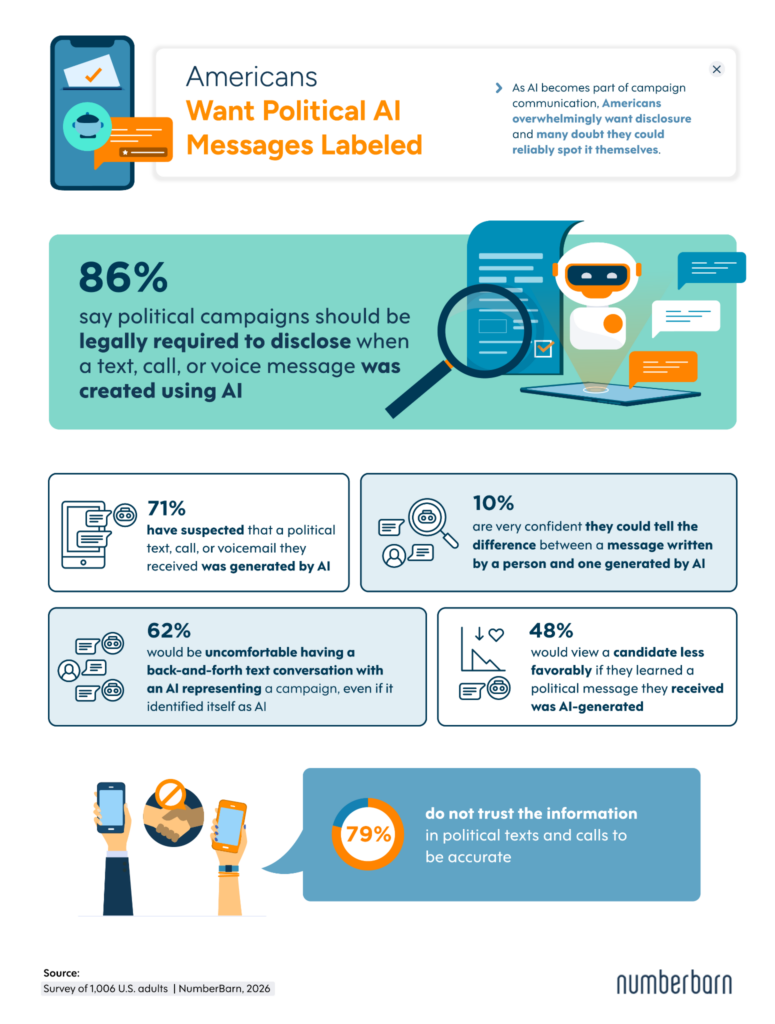
More than 7 in 10 respondents (71%) say they have suspected a political text, call, or voicemail they received was generated using AI. Yet just 10% say they are very confident they could tell the difference between a message written by a person and one generated by AI.
Most also want more transparency. More than 8 in 10 Americans (86%) say political campaigns should be legally required to disclose when a text, call, or voice message was created using AI.
And even with disclosure, 62% say they would be uncomfortable having a back-and-forth text conversation with an AI representing a campaign.
Do Americans Trust Political Calls and Texts?
Trust may be one of the biggest challenges facing political outreach.
Nearly 8 in 10 Americans (79%) say they do not trust the accuracy of the information they receive through political calls and texts.
Political calls and texts are unlikely to disappear anytime soon, but the findings suggest that more messages do not necessarily mean more influence, trust, or engagement.
As Americans grow accustomed to screening unknown numbers, blocking spam texts, and questioning the origin of every message — whether it’s a candidate, a scammer, or AI — reaching a voter’s phone is getting easier, but winning their attention remains the real battle.
Methodology
In September 2026, NumberBarn surveyed 1,006 U.S. adults to better understand how Americans experience political calls, text messages, and other election-related communication ahead of the 2026 midterm election.
Respondents answered questions about how often they receive political calls and texts, how they respond to those messages, whether political outreach affects their views or voting behavior, their experiences trying to opt out, and their attitudes toward AI-generated political communication.
The estimated weekly volume of political calls and text messages was calculated using the midpoint of each response range provided in the survey. Because the highest response category was open-ended, those figures should be interpreted as estimated averages rather than exact counts.
Demographics
The survey sample included a diverse cross-section of Americans:
Gender: 51% female, 48% male, and 1% identified as non-binary, transgender, or another gender identity.
Average age: 46
Age range: 22% between 55 and 64, 18% between 25 and 34, 17% between 35 and 44, 16% between 45 and 54, 16% 65 or older, and 12% between 18 and 24.
Voter registration: 92% registered to vote, 6% not registered, and 2% unsure.
Limitations
Survey results are self-reported and may be subject to recall bias or differences in how respondents interpret political communication. The findings reflect the experiences and perceptions of the surveyed respondents.
Fair Use
When using this data and research, please attribute by linking to this study and citing NumberBarn.
Media Inquiries
For media inquiries, contact media@numberbarn.com.