


Turns out, ghosting isn’t just happening on dating apps. For many Americans, it’s become an increasingly frustrating part of looking for a job.
Job seekers are spending hours filling out applications, preparing for interviews and speaking with recruiters, only for communication to stop suddenly. In some cases, candidates are reporting making it all the way through multiple interviews or even receiving a verbal job offer before an employer doesn’t reject… they simply disappear.
But are certain people getting ghosted more than others?
To find out, NumberBarn surveyed Americans who applied for a job within the past year across major U.S. metropolitan areas.
We looked at how often employers stopped communicating and how far candidates made it through the hiring process before being ghosted. We also explored the other side of the hiring divide: how often are job seekers ghosting employers? Are automated hiring processes driving people away? Not to mention, what are these “ghost jobs” people are talking about?
Key Findings
- Miami ranks No. 1 for employer ghosting, followed by New York City, Washington, D.C., Austin and Seattle.
- Nearly two-thirds of job seekers (66%) have been ghosted after speaking with or interviewing with someone at a company.
- Nearly 1 in 5 (18%) received a verbal job offer only for the employer to stop communicating afterward.
- Nearly half (48%) have stopped pursuing a job because the hiring process felt too automated or AI-driven.
- More than two-thirds (69%) have applied for a job they later suspected wasn’t actually available.
- Job seekers are ghosting employers back: 34% have intentionally stopped responding to an employer because of how they were treated during the hiring process.
Where Are Job Seekers Getting Ghosted the Most?
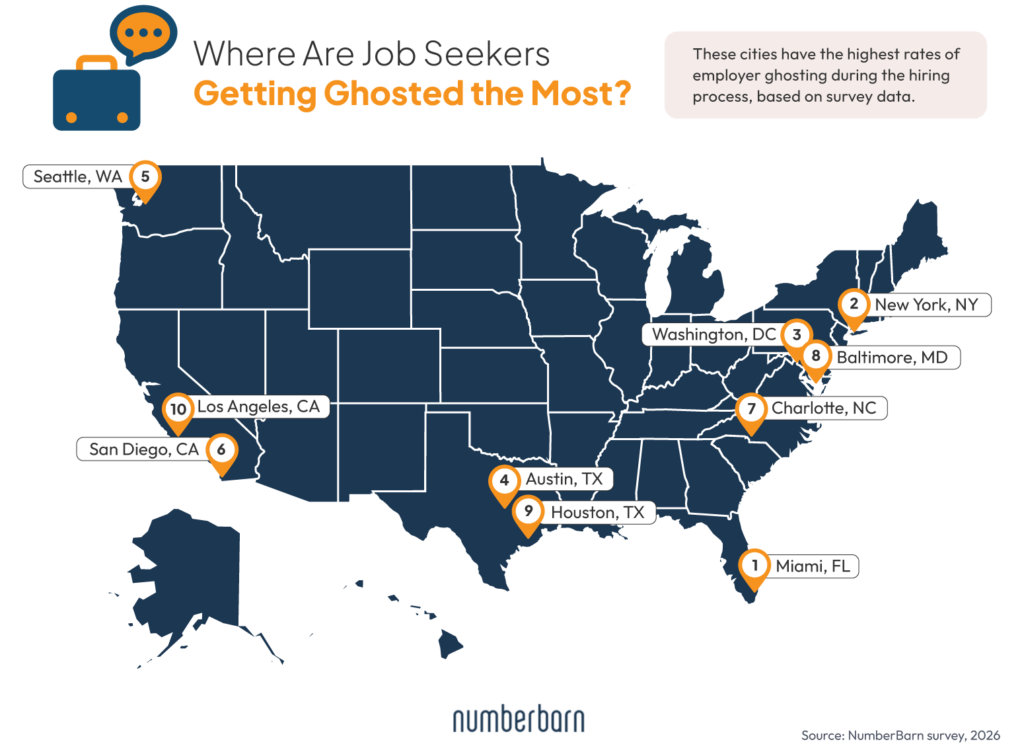
When it comes to employer ghosting, job seekers in some cities appear to be having a rougher time than others.
Miami ranks as the worst city for employer ghosting.
Here are the top 10 cities for HR ghosting:
- Miami
- New York City
- Washington, D.C.
- Austin
- Seattle
- San Diego
- Charlotte
- Baltimore
- Houston
- Los Angeles
To create the ranking, we compared several measures of employer ghosting, placing the greatest weight on candidates who were ghosted after an interview or after receiving a verbal job offer.
Miami’s position at the top is notable given its large hospitality and tourism industry. Nationally, hospitality and food service workers reported the highest rate of ghosting after a verbal job offer at 30%. Similarly, seventh-ranked Charlotte is a major banking hub, while finance and banking workers reported the second-highest rate at 26%.
“Nearly half of job seekers (48%) said they have stopped pursuing a job because the hiring process felt too automated or AI-driven.”
Meanwhile, major tech hubs Austin and Seattle rank fourth and fifth, respectively. It’s worth noting that San Francisco lands much lower at No. 21, despite its concentration of technology companies and reputation as one of the country’s largest tech employment markets.
The rankings reflect the experiences of job seekers living in each metro area, who may be applying for local, remote or out-of-market positions.
Ghosted by HR: Where Job Seekers Get Ghosted the Most
Ranking U.S. cities based on employer ghosting during the hiring process
| # | City | Ghosting Score | Verbal Offer Ghosted |
Post-Interview Ghosted |
Avg. Times Ghosted |
|---|
How Common Is Employer Ghosting During the Hiring Process?
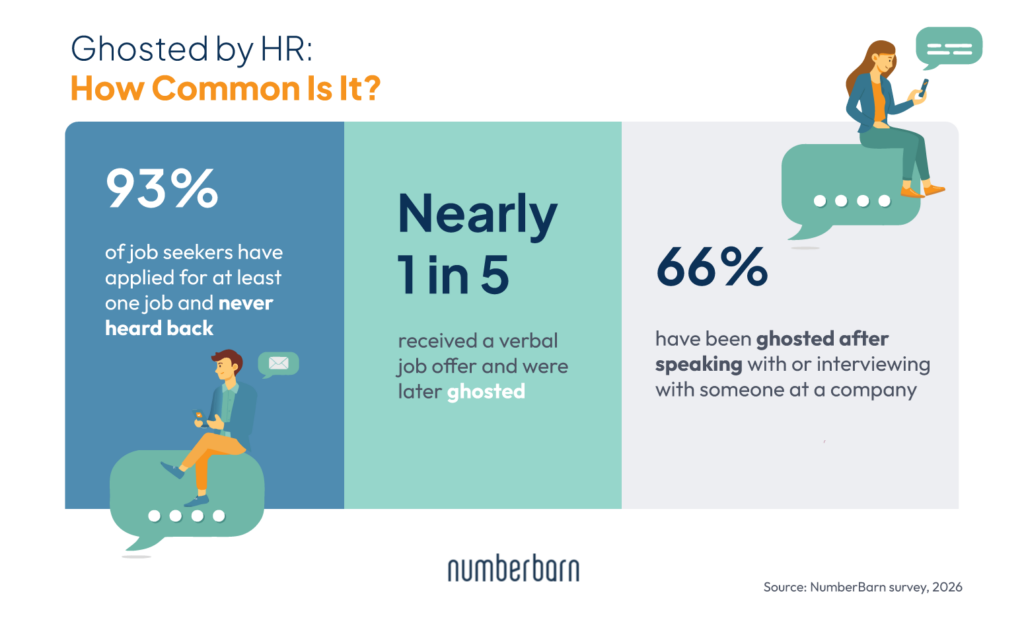
For many job seekers, submitting an application and never hearing back has become almost expected. More than 9 in 10 job seekers (93%) said they applied for at least one job in the past year and never received a response.
But the silence doesn’t always stop at the application stage.
Nearly two-thirds of job seekers (66%) said an employer has stopped communicating after they had already spoken with or interviewed with someone at the company. And even a job offer doesn’t guarantee a response. Nearly 1 in 5 (18%) said they received a verbal offer, only for the employer to stop communicating afterward.
The deeper candidates get into the hiring process, the more frustrating that silence can become. More than one-third (38%) reported being ghosted after a first interview, while 13% said it happened after a second or later interview. Another 8% were ghosted after a final interview, and 8% said an employer disappeared after telling them they were a finalist.
Is AI Driving Job Seekers Away From the Hiring Process?
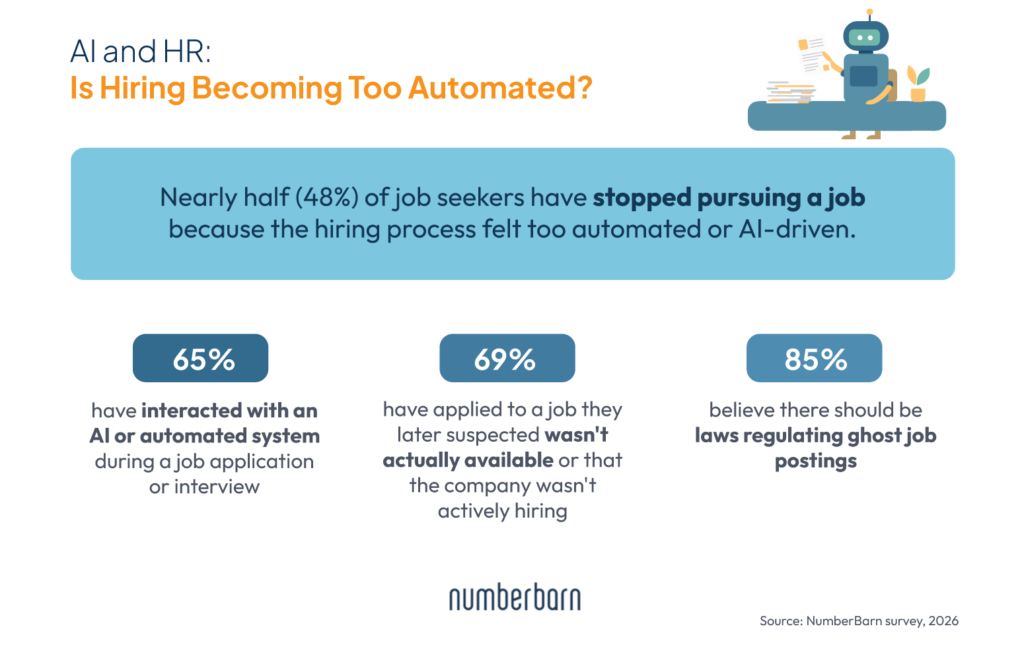
AI is becoming a bigger part of the hiring process, yet not every job seeker is embracing the shift.
Nearly two-thirds of respondents (65%) said they interacted with an AI or automated system during a job application or interview within the past year. For some, automation was enough to make them walk away entirely.
Nearly half of job seekers (48%) said they have stopped pursuing a job because the hiring process felt too automated or AI-driven. Younger workers were especially likely to draw the line, including 59% of Gen Z respondents, compared with 48% of Millennials and 38% of Gen X.
Job seekers are also questioning whether some of the opportunities they’re applying for are real. More than two-thirds (69%) said they have applied for a position they later suspected wasn’t actually available, or that the company wasn’t actively hiring.
So-called “ghost jobs” (positions companies post without actively intending to hire) are generating support for greater oversight, too. More than 8 in 10 respondents (85%) believe there should be laws regulating job postings for positions companies aren’t actively trying to fill.
Job Seekers Are Ghosting Employers Back
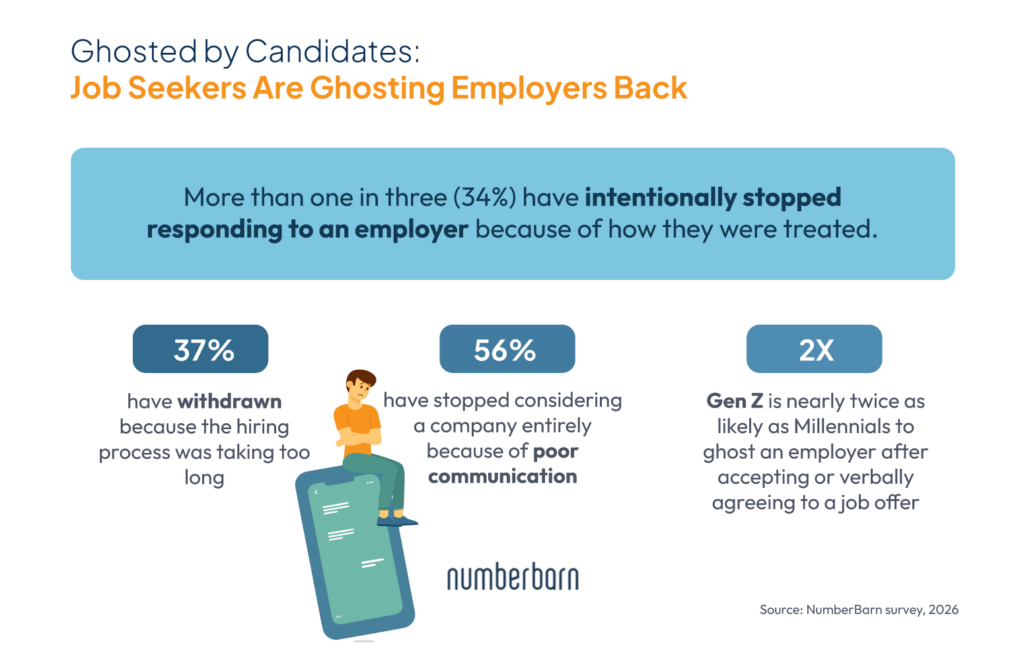
Employers aren’t the only ones going silent during the hiring process.
More than one-third of job seekers (34%) said they have intentionally stopped responding to an employer because of how they were treated during the hiring process. Another 37% have withdrawn from consideration because the process was taking too long.
Poor communication can also cost companies potential hires altogether. More than half of respondents (56%) said they have stopped applying to or considering a company because of how poorly it communicated during the hiring process.
Gen Z appears to be experiencing both sides of the ghosting divide. Nearly one-quarter of Gen Z job seekers (24%) said an employer ghosted them after a verbal job offer, the highest rate of any generation. At the same time, 16% of Gen Z-ers admitted to ghosting an employer after accepting or verbally agreeing to an offer themselves. That’s roughly double the rate of Millennials (9%) and Gen X candidates (8%).
The impact may extend beyond a single application. More than 6 in 10 job seekers (61%) said their experiences with the hiring process have made them trust employers less than they did a year ago.
The findings suggest hiring ghosting may be becoming a two-way street, with poor communication affecting not only whether candidates stick around, but how they view employers more broadly.
Methodology
In August 2026, NumberBarn surveyed 1,411 Americans across the 30 largest metropolitan areas in the country who had applied for at least one job within the past 12 months to better understand their experiences with employer ghosting, hiring communication, AI in the hiring process, and ghost job postings.
To determine where job seekers are getting ghosted the most, we created an overall Employer Ghosting Score using four survey metrics:
• Post-interview ghosting (35%): The percentage of respondents who said an employer stopped communicating after they had spoken with or interviewed with someone at the company.
• Verbal offer ghosting (35%): The percentage who received a verbal job offer from an employer and were later ghosted.
• Ghosting frequency (20%): The average number of times respondents were ghosted after speaking with or interviewing with an employer within the past 12 months. Results were normalized across cities on a 0-100 scale.
• No response after applying (10%): The percentage who applied for a job and never received a response from the employer.
Greater weight was given to ghosting later in the hiring process, particularly after an interview or verbal job offer, when candidates had already established direct communication with an employer.
City rankings reflect the experiences of job seekers living within each metro area. Respondents may have applied for local, remote, or out-of-market positions, so the rankings reflect where job seekers experience the most employer ghosting rather than the location of the employers themselves.
Survey results are self-reported and are subject to the margin of error associated with a sample of this size.
Demographics
The survey respondents included 55% females, 44% males, and 1% identifying as non-binary/non-conforming. The average age of the respondents was 38 years. Limitations: The survey responses rely on self-reporting, which may be subject to recall bias or social desirability bias.
Fair Use
When using this data and research, please attribute by linking to this study and citing NumberBarn.
Media Inquiries
For media inquiries, contact media@numberbarn.com
Illustrations by Kyle Smart