
Getting a phone number for your business used to be pretty straightforward, before you were able to, you know, choose it.
But today, options abound.
You can choose a local number with an area code that matches your city, go with a toll-free number like “1-800” or “1-888,” or even buy a memorable “vanity” number that spells out a word, pattern, or easy sequence of digits.
So which one should you choose?
There isn’t one answer that works for every business. Your type of customers, where your business physically operates, and how you plan to use the number all make a difference.
Do 1-800 or vanity numbers actually matter?
They definitely do!
Your phone number isn’t going to make or break a business by itself, but a memorable number can make it easier for customers to remember how to reach you. A personalized 1-800 number can make your business feel more legitimate all by itself.

NumberBarn’s research into vanity phone numbers found that nearly 85% of respondents said they were more likely to remember a vanity number after seeing or hearing it in an advertisement. The study also found that roughly 35% said they would be more likely to call a business using a vanity number than one using a standard number.
That’s not to say you need to turn your literal company name into a phone number (although that’s not a bad idea). A number can be memorable simply because it has an easy pattern or sequence. (People shell out big bucks for a number that ends in something like “7777,” should they become available.)
The bigger question isn’t if they work, but what kind of number fits your business.
How do I get a 1-800 number?
There are several ways to get a toll-free number.
Yes, traditional phone companies sometimes offer them, as do some VoIP providers and online phone-number services.
But through the big guys, you’re beholden to how big their specific database happens to be (and usually, they don’t let you choose which digits you receive.) Meanwhile, services like Google Voice don’t allow creation of toll-free numbers.
But if the provider you have doesn’t offer personalized digits, or have the phone number you want, you might still be able to get it elsewhere, like through an online phone number marketplace.
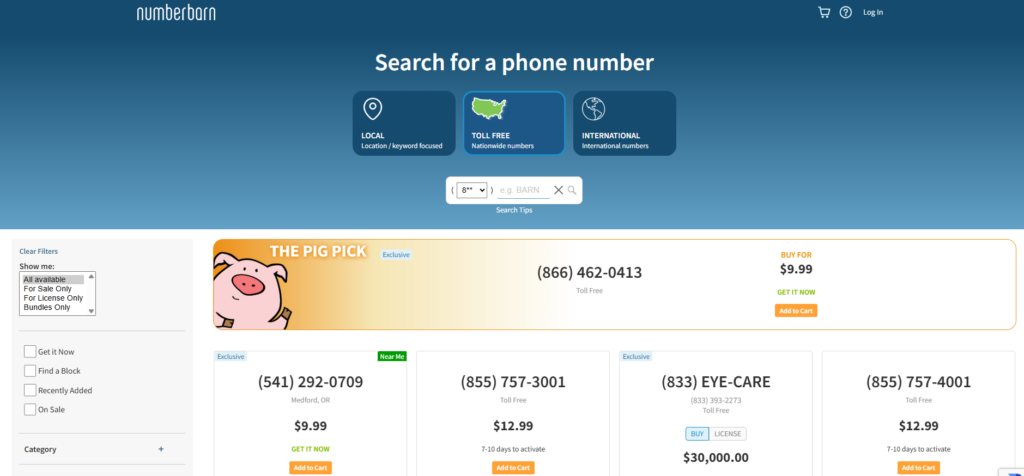
NumberBarn is an online marketplace where you can search for the exact digits you want
This is super useful if you’re looking for something memorable, or specific. Again, online, you can search for a number that spells out part of your business name, relates to what you sell, or has a simple sequence that’s easy to repeat.
And you don’t necessarily need a new phone to use it either! Toll-free calls can be forwarded to an existing cell phone, landline, or other phone system, which means your customers can call your new business number without requiring you to completely change the way you handle calls.
How to get a 1-800 number online:
- Search: Find an available toll-free number
- Choose: Pick the number that makes sense for your business
- Activate: Set it up with the phone service you want
- Forward: Send incoming calls to the phone or system you already use
Browse available toll-free numbers at NumberBarn
How much does a 1-800 number cost?
The short answer: it depends. (But not necessarily a lot!)
First, let’s clarify the difference between the cost of the number itself, and the billing associated with its service.
Originally, when toll-free numbers were created in 1967, they allowed customers to call businesses at no charge to the customer (hence the name “toll-free”). Instead of billing the callers, the businesses paid the cost of the incoming calls. Theoretically, this is still the case. But with cell phones, unlimited calling, etc. billing for toll-free numbers has changed – now it just depends on the phone number’s provider.
Now let’s get to the cost of a toll-free number itself. With NumberBarn, toll-free numbers can cost as little as $9.95 to purchase, with plans as little as $2.99 per month depending on which one you choose. There are no contracts, and you can even park (ie.g, store or save a number without outbound calling) and add voicemail for just a few bucks a month. That gives businesses a relatively inexpensive and flexible way to establish a toll-free presence.
That said, some very particular and desirable toll-free and vanity numbers can be more expensive to acquire, especially if they spell a popular word. (Some famous companies center their entire business around their memorable phone number, so the price is well worth the cost to them.)
Just know the vast majority of 1-800 numbers are much more affordable. And, many high-value toll-free vanity numbers are also offered for licensing (like renting), which can also allow you to use the number at a more affordable price for just the amount of time you need it.
The cost of monthly plans, additional features or users, etc. vary too, but generally, it isn’t anywhere near as expensive as adding a phone line through a major phone provider.
If you’re a small business owner thinking, “I’d love a 1-800 number, but I don’t want another huge monthly bill,” it’s worth checking marketplaces and service providers like NumberBarn first!
1-800 vs. 1-888: Does the prefix matter?
By the way, “1-800” isn’t the only toll-free prefix.
There are several toll-free prefixes in use today, including:
- 1-800
- 1-888
- 1-877
- 1-866
- 1-855
- 1-844
- 1-833
They’re all toll-free numbers! That’s great news, because it greatly increases the number of memorable digits that are available online. (Just as a refresher, “toll-free” simply means callers do not incur a long-distance fee when they’re dialing far away.)
There is nothing “better” about “1-800,” other than it being more memorable, offhand. If you find available 1-888 digits that are significantly easier to remember than the 1-800 alternatives, the memorable digits are probably the better choice.
Okay, what about a local area code?
This is where things get a little more interesting.
A local number actually may make sense if your business is genuinely local.
If you’re a plumber serving one city, or if you’re a neighborhood restaurant or some other local service, a familiar area code often reinforces the idea that you’re part of the community.
Thus, grabbing a familiar area code may actually be more beneficial to your business!
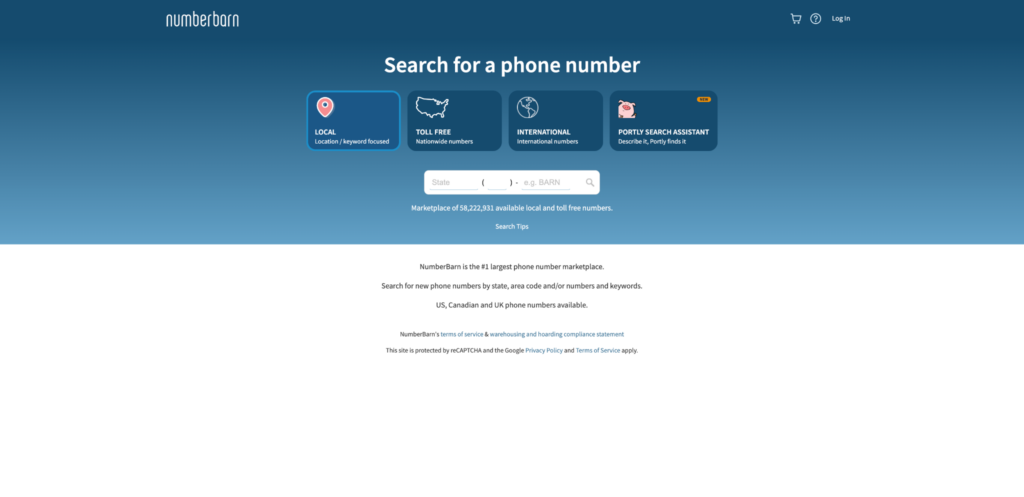
Search for a local number with any area code you need
That’s compared to a company serving customers throughout a state or across the country, which may not get much value from tying itself to one particular city. In those cases, a toll-free number can make more sense if it doesn’t need to be associated with one geographic location.
(But just so you know, there are plenty of businesses that serve local customers while using toll-free numbers… there’s no rule saying a local business can’t have a 1-800 number!)
So, should your business get a local number or a toll-free number?
It’s really a question of what you want the number to communicate.
Think about where your customers are and how they encounter your business.
| If your business… | You might consider… |
|---|---|
| Primarily serves one city or community | A local area code |
| Serves several cities or regions | A toll-free number |
| Operates nationally | A toll-free number |
| Relies heavily on advertising | A memorable or vanity number – toll-free or local |
| Wants to emphasize its local roots | A familiar local area code |
| Wants one number customers can remember anywhere | A toll-free vanity number |
There’s plenty of overlap here. A local business can absolutely benefit from a memorable 1-800 number, just as a national company can use a local number.
The important thing is to think about your customer first, rather than assuming one type of number is automatically better. What will be more effective for reaching your audience and creating more trust? A strong, reputable 1-800 number, or a community-focused local number?
Can’t decide? Speak with our real-human Solutions Team, we’re happy to help guide you in the best direction for your brand!
Click here to search for affordable 1-800 numbers.
Click here to search for affordable local numbers.