

Are you looking for a business number?
Maybe you just started a small business selling lawn flamingos from your basement. (Congrats, by the way.) You’re probably looking to separate your business calls from your personal ones.
Or maybe you’re expanding operations and opening a new branch of a corporate office. Now you gotta fill an entire office building with brand new office numbers inside every single cubicle. (Congrats, again.)
No matter where you are on that spectrum, hunting for free or cheap business numbers is harder than it needs to be. Confusing terms that sometimes mean the same thing, and oftentimes don’t (e.g., “VoIP,” “virtual number,” “vanity number,” etc.), and tons of complicated phone plans that all cost different amounts can make it tough to even figure out where to start.
To help you (and your flamingos) out, we’re here to break down the business of business numbers.
How To Get A Business Number
Getting a business number is simple… except when it’s not.
Here’s what we mean.
Typically, business numbers are the “same” as regular phone numbers, in the sense that a phone number is a phone number is a phone number.
The way a business number may be different is based on:
- How you plan to use the phone number
- The plan associated with that number
- How its pricing structure works
- What features (and limitations) your chosen option comes with
Option #1: Get a Business Number Through a Major Phone Provider
Of course, you can just order a business number through one of the big guys (i.e., AT&T, Verizon, or T-Mobile). You just go online or call and ask for one of their many “Business Plans.”
Because of their reliability, this is often the way to go for medium-sized businesses.
But before you do, let’s consider your use case and the logistics of how you plan to actually use your new business numbers. Do you want to purchase new, separate, dedicated cell phones for you and your staff? Or would you like your staff to try to use their existing personal phones while adding a separate line to them?
While T-Mobile and Verizon offer their own app or hardware-based workarounds to accommodate adding multiple lines to one device, currently AT&T does not. So for AT&T you may need to keep the first scenario in mind, which many businesses and employees may prefer despite the inconvenience of two separate devices.
Here’s a quick review of business plan options and pricing in 2026 with the three major carriers.
Note: Listed prices are an approximation, and are subject to change based on things like your geographical area’s availability and updated pricing.
AT&T Business Unlimited
~$30-60+ per month, per line (with at least six lines)
As of this writing, AT&T offers four (4) tiers of business plans:
- Standard 3.0
- Advanced 3.0
- Premium 3.0
- Ultimate 3.0
AT&T’s Business Plan offers:
- Unlimited talk, text, and data (though the “Standard” Plan may throttle data after 75GB)
- 5G
- “Security” features
- At least 5GB of mobile hotspot data (standard definition video streaming)
The higher tiers offer more data, higher-quality video streaming, and additional services like Latin American roaming, free international passes, and “Turbo” priority network connectivity.
T-Mobile Business Unlimited
~$21-41+ per month, per line (with at least six lines)
As of this writing, T-Mobile offers three tiers of business plans:
- Super Mobile
- Core Mobile
- ProMobile
T-Mobile’s base Business Plan offers:
- Unlimited text and talk
- 50GB data (and 5GB in Mexico and Canada)
- 5GB hotspot data
- “Scam shield” and secure Wi-Fi
Higher-tier plans include more data (unlimited in the top two tiers), “improved” scam protection, in-flight Wi-Fi, and satellite internet.
Verizon “My Biz” Plan
~$65+ per month, for one line
Verizon is a little different, in that it offers a single plan with add-on features, not tiers. The more lines you add, the cheaper the monthly fee per line gets.
When you turn on auto-pay, the base costs* are:
- 1 Line: ~$65
- 2 Lines: ~$55 per line
- 3 Lines: ~$40 per line
- 4 Lines: ~$34 per line
- 5+ Lines: ~$29 per line
*Prices are subject to regional and national changes. Check their website for the most up-to-date pricing in your area.
Verizon’s base Business Plan includes:
- Unlimited talk, texting, and data
- 5GB mobile hotspot data
- Call filter
- Canada + Mexico talk/text/data
ADD ONS: For anywhere between $5-$15+ per line, you can add stuff like:
- Google Workspace with Gemini AI ($16 per month)
- International calling ($10 per month)
- Discounted long-distance calling by region ($5 per month, per region)
- Unlimited cloud storage ($10 per month)
- And more
Why you SHOULD do this: A number serviced through a major phone provider relies on cellular service and is not internet-bound (like we’ll see with VoIP numbers) or landline-based. Coverage from major wireless carriers is generally more consistent based on their ownership of vast amounts of telecommunications infrastructure globally and carrier partnerships.
These numbers and plans also typically perform better in the areas of international calling, but rates and roaming charges can stack up fast. (Some online phone services don’t even offer international calls!)
Business numbers serviced by major providers will invariably also be tied to your geographic location, which can help build trust signals in the case that you are a local business. (People recognize their own area codes!)
Why you SHOULDN’T do this: Above all, cost!
First, you typically need to invest in an expensive business-tier phone plan and maybe even new cell phones for each of your staff, depending on which carrier you choose. Plus, there’s often a hefty minimum to the number of lines these plans require, making this an option more for larger-scale companies. (Your Etsy shop probably doesn’t need a minimum of five phone lines. Your new corporate office might.)
Second, you almost certainly don’t get to choose what the digits will be. In some cases, that really matters.
Third, whether you’re adding onto an existing plan or not, you’re subject to whatever deals, contracts, or processes a major carrier happens to be offering in your specific area, and during a specific time window.

Also worth noting, if you go with one of the smaller phone providers or MVNOs (e.g., Mint Mobile, Boost, etc.), while they “piggyback” on the major carrier networks, things like customer support, technical assistance, and wireless coverage may be less dependable. This could be especially bad for national or even multi-regional businesses. (It may still be worth comparing and contrasting these companies’ current deals, if you do happen to have reliable coverage everywhere you need it.)
Option #2: VoIP Internet Number Subscriptions
If you searched online for “business number” or “free business number,” congrats, you’re now rich in websites trying to sell you internet number subscriptions!
“VoIP” stands for “Voice over Internet Protocol.” In short, it’s a type of phone number that operates using a broadband internet connection, as opposed to a physical phone line.
The benefit of a VoIP number in a business context is that you can theoretically get one for as little as free, or a few bucks, and they often come enhanced with nifty online dashboards, features, and tools. They’re frequently a go-to for bulk number orders.
The downsides, in a business context, are plenty. First and foremost, VoIP numbers are completely internet-dependent. So if you’re business staff is on-the-go at all, this factor alone can complicate things. Additionally, they have a slightly higher risk for security vulnerabilities than a traditional landline or completely wireless system. And if network traffic gets too heavy, call quality can suffer.
Also, depending on where you get the number from, you might not be able to personalize your business number in any way.
There are many VoIP phone providers – too many to list, in fact. Some of them include:
- Ring Central
- Google Voice
- Grasshopper
- Vonage
- Zoom Phone
- OpenPhone/Quo
What VoIP subscriptions for business numbers typically get you
If we listed every single plan for every single VoIP provider detailing every single nuance, this article would be around 500 pages.
What we can do is synthesize how these offerings generally work, as well as explain their pros and cons.
Typical VoIP Business Plan Structures:
- VoIP plans often run on a “subscription” fee.
- These typically begin with “Free” or “Basic” Tiers featuring heavy restrictions, followed by Business Tiers that feature, frankly, must-have features for most businesses. They’re often called “subscriptions” in addition to “contracts,” yet they can be fairly similar to your personal phone’s contract.
- With VoIP numbers, you frequently are marketed access to broader Customer Relationship Management (CRM) tools, versus what the major phone providers give you (at least, out of the box).
- This often includes things like voicemail management, caller ID features, auto attendant menus (i.e., “Press ‘1’ for…”, extensions, etc.), call-back features, internal team messaging, scheduling, SMS/texting, and lots more.
- These typically come in the form of an app, or through logging into an account via a browser.
How much are VoIP subscriptions?
VoIP subscription tiers for companies like Grasshopper, Ring Central, Google Voice and more range pretty widely, from ~$15 to ~$50+ a month, sometimes to hundreds of dollars per month. In some cases they come technically free with a trial, or under severely limited accessibility.
Many VoIP number companies charge per line, instead of, or in addition to, their service tiers. That means your true cost will directly correlate to the size of your company.
So for example, on one end of the spectrum, Google Voice grants you a free, randomly generated number for immediate use on your phone or computer simply by making an account. (You can lose the number if it has 90 days of inactivity, so don’t put it on any marketing content unless you know you’re ready to use it.) That number will have limits for where it can call and who can call it, and will be tied to your Google account and Google ecosystem. You can upgrade it to a more expensive tier for better service.
Meanwhile, for a VoIP company at enterprise-scale like Ring Central, you will likely need to get a quote after doing a call or interview, and that price will be based on your specific business’ scale. (Some VoIP companies have non-mandatory consultation options too.)
On average, with any digital phone number company, you’re probably going to be paying roughly the same as a personal phone plan, per month — at minimum. In some cases, you’ll additionally be paying per line, per tier, or both. (The “free business number” stuff is typically only for the absolute most “soloponeur” scenario imaginable.)
Why you SHOULD do this: A quick and low-cost-tier digital number is just what the doctor ordered for those just-starting-out businesses, especially if you don’t need to worry too much about 24/7 internet connectivity, complex customer needs, or brand perception. (Sometimes, you’re only doing this so people don’t see your personal number on a billboard!)
For enterprise bulk number orders, the higher cost business tiers may be the most viable option, especially compared to buying dozens of lines through Verizon, for example. (And for the physical cubicle desk phone scenario, hosting landlines would cost thousands of dollars, versus hundreds for VoIP numbers.)
Since VoIP subscription models tend to place emphasis on CRM tools, they can be appealing as straight-out-of-the-box solutions, if the contract you sign checks all the boxes you need, and you can afford it.
Why you SHOULDN’T do this: For business use, there are many cases where it isn’t any cheaper to buy a digital number versus a cell or landline (also known as “wireline” number). There are many cases where it would cost considerably more, in fact.
VoIP numbers are obviously also subject to a strong internet connectivity framework, which means if the internet or power goes out, typically, so does your business. (Internet-based coverage can also mean you are subject to cyber security concerns.)
Digital number solutions also require compatible infrastructure (relative to a literal phone), so depending on your scenario, they might require an IT department.
Also worth noting that with some VoIP companies, you can choose your digits, including 1-800-style vanity numbers (aka toll-free vanity numbers), (though you will be limited by the offerings that specific company has in their inventory) and then you can port over your preferred phone numbers to your preferred provider or carrier.
Option #3: Phone Number Marketplace Activation (~$10+ for a Real Business Phone Line)
Using a phone number marketplace to grab a number of your choice to go with any plan of your choice is what we’re calling “the goldilocks option.”
It’s kinda like a hybrid of all of the above, the happy medium between getting the benefits of a business plan through a major carrier, but with most of the flexibility and features of a VoIP number.
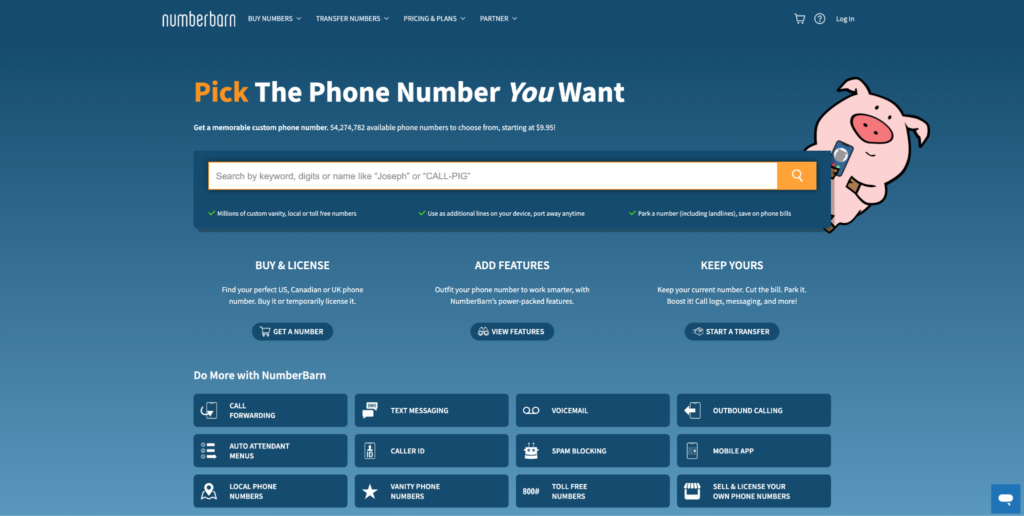
How does NumberBarn work?
The fundamental difference with this type of business number is that with an online marketplace like NumberBarn, you don’t need any new devices, you aren’t locked into any contract and you still get affordability and scalability.
While NumberBarn phone numbers are technically considered “wireline,” they also have VoIP features and functionality. So you have plethora of different ways to use a NumberBarn phone number. You can pick the phone number you want, complete with custom patterns or spellings to reinforce your brand and marketing. Then you can use NumberBarn’s ultra-budget friendly plans to make your phone number work exactly the way you need it for whatever stage your business is in.
Maybe you haven’t even formally launched yet, and you’re just exploring options for having a business number. You could find your perfect business number, purchase it at NumberBarn and then choose NumberBarn’s “parking” option to save it for later, when you’re ready to add more functionality with it or port it (transfer it) elsewhere.
Once you’re ready to start using the number, the simplest and most cost-effective option for most brand-new small businesses is just to activate the standard call forwarding plan at $6.99 a month. You can send incoming business calls directly to your existing cell phone with callers only seeing your business number that they dialed. When someone calls your phone using your business number, you’ll appear to them as that entity, while your personal calls remain the same as before.
To activate a new business number online:
- Search for the exact digit(s) you want (or start by picking the area code or toll-free code you want).
- Purchase a phone number that fits your budget (as low as $9.95).
- Pick a plan.
- Port the number to your personal phone plan (this can take up to 10 days, depending on your provider).
- Stay with NumberBarn (see plan options below).
You’re also choosing the digits themselves, so your business plan can include a 1-800 (toll-free), or local vanity number of your choosing.
Given that the fees associated with setting up a marketplace number are just a few dollars and one-time fees, this ends up being a considerably cheaper option in many business cases, with much of the same value of VoIP and major phone provider options.
Price plans:
Porting: FREE if you port away within 30 days of purchasing (otherwise your account will default to the Number Parking plan).
Number Parking: From $2.99/month per number, with lots of extra features like call logs, etc.
Call Forwarding Plans: From $6.99/month per number for 600 minutes (which most plans will fall under) to $19.99/month per number for unlimited minutes. Includes auto attendant menu options to forward to up to ten different phone numbers.
Business Plans: Starting at $9.99/month for one user with one phone number and unlimited minutes. For larger businesses, each additional phone number is $9.99/month and each additional user is $4.99/month.
And keep in mind that all of these plans are non-contractual, so you can cancel at any time and/or take your number to any other provider of your choice.
How do the features of a NumberBarn Business number compare to VoIP features?
Depending on where you are at with your business needs, NumberBarn’s basic call forwarding plan has plenty of features for a brand new business. When you’re ready to expand, NumberBarn Business Line offers features like after-hours call scheduling and routing, the ability to send incoming calls to multiple users at once (called simultaneous ring), unlimited forwarding minutes and more.
Here’s a snapshot of NumberBarn’s standard call forwarding plans compared to a Google Voice internet-dependant number:
| Features | NumberBarn | Google Voice |
|---|---|---|
| Call Forwarding | ✅ Yes | ✅ Yes (limited options) |
| Call Recording | ❌ No | ✅ Yes (paid only) |
| Mobile App | ✅ Yes (iOS/Android) | ✅ Yes (iOS/Android) |
| Phone Number Parking | ✅ Yes | ❌ No |
| Porting In/Out | ✅ Yes | ✅ Yes |
| SMS/Text Messaging | ✅ Yes (Add-on for $1/mo)* | ✅ Yes (U.S. numbers only) |
| Toll-Free Numbers | ✅ Yes | ❌ No |
| Vanity Numbers (Custom #’s) | ✅ Yes | ❌ No |
| Voicemail | ✅ Yes (email transcription) | ✅ Yes (web transcription) |
Why you SHOULD do this: You get the tangible benefit of a business plan without the contract, more consistency than an internet-dependent VoIP service, power-packed features at budget-friendly prices, and lots of versatility to use your business number in a way that grows with your company’s needs.
You can choose the digits you want, at the price point you want.
It can take minutes to set up. You don’t need any quote or business assessment. (Tip: For NumberBarn, look for phone numbers with the label “GET IT NOW” for faster activation and immediate use with NumberBarn’s plans. Activating and porting away can take up to two weeks depending on the type of phone number you choose.)
If you need to keep your number, but reduce your monthly obligations, you can “park” your number. Call logs show you who’s called and when, and you can even add voicemail (with transcription) for just $2/mo, and texting for $1/mo to parked numbers. So if you just need an quick, cheap, public-facing phone number without enabling calling, parking is a great option. No contracts!
Why you SHOULDN’T do this: Getting a business number through an online marketplace still requires a phone provider of some kind. (NumberBarn call forwarding transparently sends calls from your new business number to whatever active phone number you designate, like your personal cell number.)
If you need to host multiple numbers at an enterprise scale, here’s a peak at some example configurations with competitive price points available for an admin style account with multiple numbers, but that option costs more than just getting a single business number.
Whatever your business needs, the best news is that you have plenty of options and can undoubtedly find just the right fit for your brand’s unique and evolving needs.